Mind Tapestry

Motzei Shabbos: Vayakhel-Pekudei 5783

The paroches (partition) separated between the area where the Ark was kept and the less holy area of the Mikdash (sanctuary). Consider the variety of materials used, “blue, and purple, and scarlet, and fine twined linen; with cherubim the work of the skillful workman shall it be made” (26:31, JPS 1917 Tanach). According to the Talmud, the craftsmen “embroidered the place where they had designed” (Yoma 72b). Thus, first a pattern was made on the material, then they embroidered the design.

Our thoughts are woven together, forming a tapestry in this life. The nature of our thoughts will determine the quality of the tapestry. Our thoughts surface first in our mind; these thoughts may be likened to a pattern that is based upon our soul; therefore, the design that is eventually woven in our lives is a reflection of who we are.

Yet, our personalities may often influence the overall design of our soul, either positively or negatively, dependent on what kind of thoughts occupy our minds. If only the true light of the soul could shine through, irrespective of our own limiting factors, then the woven result would reflect that light.

This has to do with the basic mechanism of the soul, inasmuch that our lower nature may interfere with our higher aspirations. Therefore, like skilled crafts-persons, we need to discern positive from negative, right from wrong, and light from darkness, so that we can weave a pure tapestry.

Additionally, consider that in regard to our thoughts, the tapestry we weave separates to some degree, between our inner sanctuary (the depths of our mind), and the persona we present to the world. Only behind the paroches (partition) of our soul, i.e., behind our thought life, we may connect on an intimate level with H’Shem, whose presence appeared upon the Ark cover, between the two golden cherubim, behind the paroches (veil).
The Wise Craftsman

weekly Torah reading: parashas Vayakhel-Pekudei 5783

 “And He hath filled him with the spirit of G-d, in wisdom, in understanding, and in all manner of workmanship.” – Exodus 35:31 JPS, 1917 Tanach

Moshe assembled B’nei Yisrael, reiterating what H’Shem had commanded to him, while on Mount Sinai, to speak to them that they bring an offering – willingly from the heart – to contribute materials to build the Mishkan (Tabernacle). Bezalel is chosen by H’Shem to oversee the entire project, that would amount to a great artistic endeavor; moreover, Bezalel is endowed by H’Shem with the Spirit of G-d (Ruach Elokim), in wisdom, in understanding, and in knowledge” (Exodus 35:31).

The Talmud notes, in Berachos 55a, that these same qualities were used by H’Shem to create the Heavens and Earth, as is found in Mishlei (Proverbs 3:19-20). This insightful comparison points towards the idea that the Mishkan (Tabernacle) itself is a reflection of Heaven on Earth.

Inasmuch that H’Shem’s Presence (the Shechinah) dwelt in the Mishkan between the two golden Cherubim on the cover of the Ark of the Covenant, from where H’Shem spoke to Moshe, the Mishkan encapsulated a smaller rendering of H’Shem’s Glory in Shomayim (Heaven), where, according to the vision of the prophet Ezekiel (see Ezekiel 10:1), H’Shem is surrounded by Cherubim.

In consideration of the designation of the Mishkan as a place where the Shechinah would dwell, it is all the more understandable why its master craftsman was endowed with the same qualities that H’Shem used to create the Heavens and Earth: a microcosm of the whole (according to Akeidut Yitzchak), the Mishkan required more than artistic capabilities; rather, it called for divine intuition, in regard to making patterns found in the Heavenly Realm.

Incidentally, that may be the reason that the most-used color of various components of the Mishkan was techiles (a specific hue of blue), denoting a similarity to “the sea that resembles Heaven; and, Heaven resembles the Throne of Glory,” as mentioned in the Talmud, tractate Menachos 43a, based on Exodus 1:24, and Ezekiel 1:26.

“The L-RD by wisdom founded the earth; by understanding He established the heavens. By His knowledge the depths were broken up, and the skies drop down the dew.” – Proverbs 3:19-20, JPS 1917 Tanach

© 2023 all rights reserved

Shabbat shalom. If you appreciate this material,
please consider contributing a few dollars to my Shabbos fund
for wine & challah: tap link, here.

Entering the Cloud

weekly Torah reading: parashas Vayakhel-Pekudei 5783

  “Then the cloud covered the tent of meeting, and the glory of the L-RD filled the tabernacle.” – Exodus 40:34, JPS 1917 Tanach

H’Shem’s Presence appeared to B’nei Yisrael, before they crossed the Sea of Reeds; at that time, H’Shem’s presence was manifest in the form of the cloud, and the pillar of fire. At Sinai, H’Shem’s Presence was accompanied by thunder and lightning (Exodus 19:18). And the cloud rested atop Sinai: “‘Lo, I come unto thee in a thick cloud, that the people may hear when I speak with thee’” (Exodus 19:9, JPS).

When Moshe was on Sinai with Aaron, Nadav and Avihu and the seventy elders of Israel, (see 24:9), he was called by H’Shem, “Come up to Me into the Mount and be there; and I will give thee the tables of stone,” and thus, “Moses entered into the midst of the cloud.” (24:18). R. Bachya explains that just as he was called to go into the cloud of H’Shem’s glory at Sinai, the only way he could enter the sanctuary when the cloud of glory filled the sanctuary was when H’Shem would first call to him (40:34, sefaria). “Then the cloud covered the tent of meeting, and the glory of the L-RD filled the tabernacle” (Exodus 40:34, JPS 1917 Tanach).

Consider that to a certain extent, a parallel lesson can be drawn from this reading, wherein we too will find that as we approach H’Shem, the way may be obscured by His glory, like the cloud atop Sinai and within the Mishkan (Tabernacle). We may find that we are not able to draw any closer to Him than we are at current, until He calls us from within the obscurity of our understanding. Then, we may enter a cloud, so to speak, of initial unknowing (like leaving our comfort zone) that will eventually bring us to a greater understanding.

© 2023 all rights reserved

If your appreciate my writing, please consider “buying me a cup of coffee” at the following link: Tap, here for link.

No Pain, No Gain

“Those who sow in tears will reap in joy.” – Psalm 126:5

Is it necessary to experience sorrow before we can truly appreciate the joy of redemption? Is this an axiom that can be applied to life in general? It is written in Psalms, “those who sow in tears will reap in joy” (Psalm 126:5). If we think about the value of pain, to learn from our suffering, then the idea begins to be credible as a principle. Thus, it follows, that our more challenging experiences in life are often the ones from where we learn the most.

A friend once related to me, how after not eating for several days, he sat at someone else’s campfire, and was able to procure some baked potatoes. He said that those potatoes tasted like the best meal he had ever had. I am using this as a simplistic example, to convey the understanding that the depths of pain have the potential to lead to the heights of joy.

The principle is reiterated, “Though he goeth on his way weeping that beareth the measure of seed, he shall come home with joy, bearing his sheaves” (Psalm 126:6). The passage conveys the understanding that in this life, we will experience sorrow; yet, in the world-to-come, we will experience joy. If we sow tears in Olam Hazeh (This World), then we will receive a joyous reward for our efforts in Olam Haba (the World to Come).

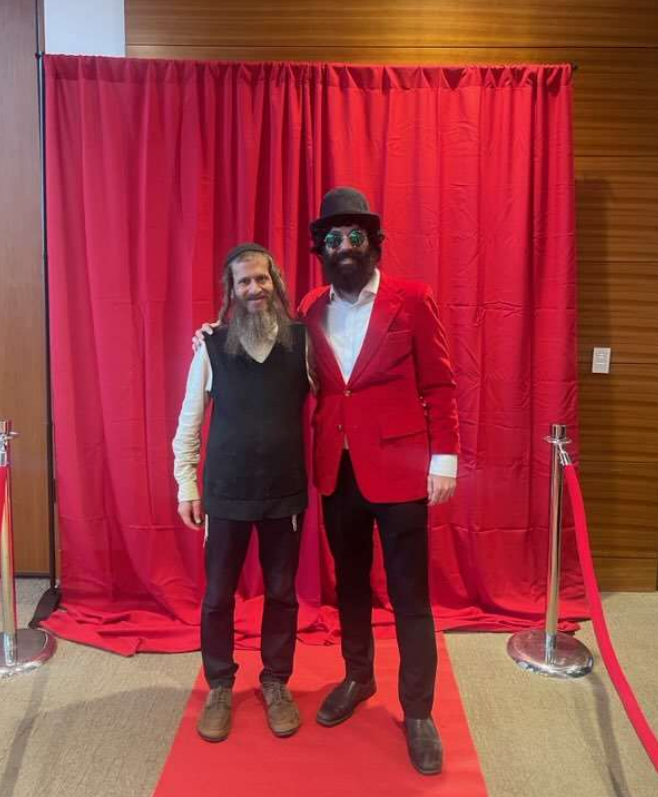
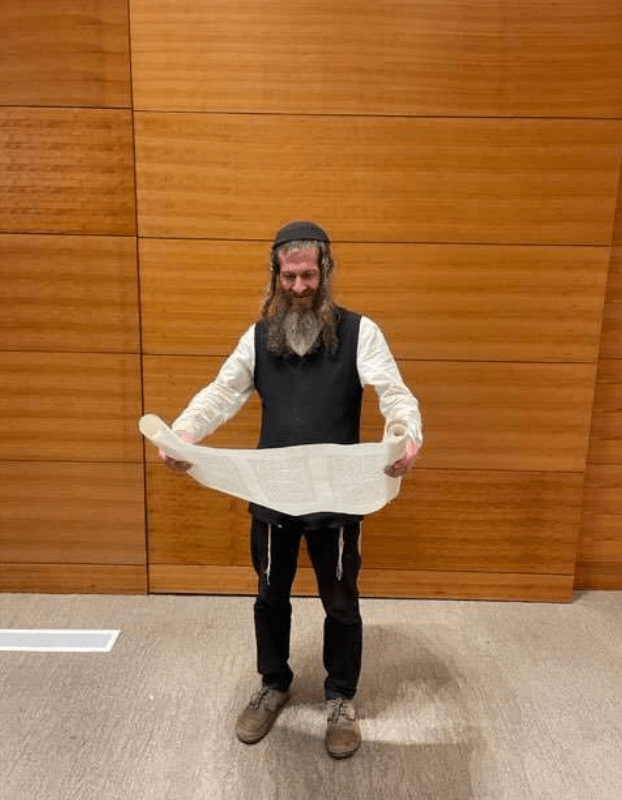
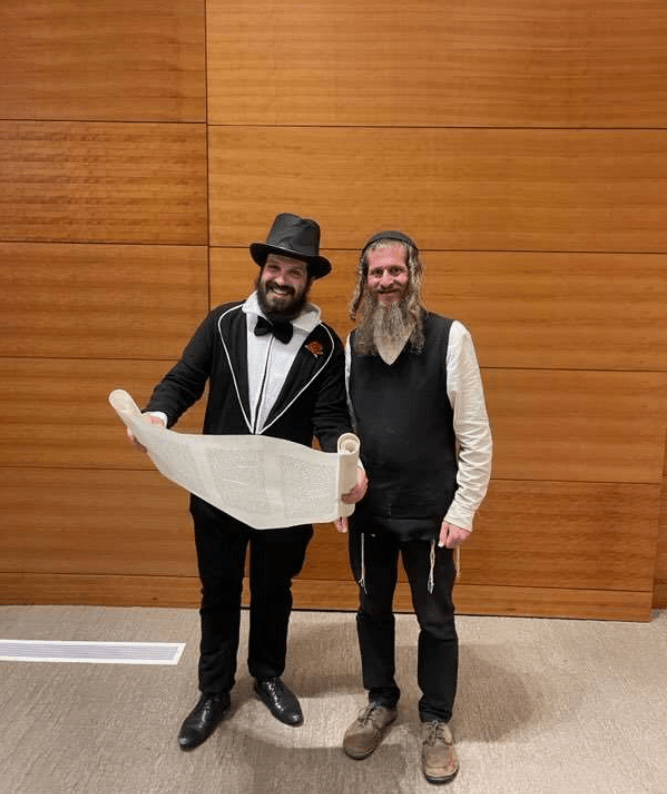
My Purim “Costume”

Me, Tzvi Fievel with the whole megillah scroll of the Book of Esther.

Myself, and the chazzan (cantor) who read the megillah.

Myself, and the rabbi, where I attend shul. (His beard is tucked under).

Yes, those are authentic peyos (sidecurls). 364 days out of the year, I wear my peyos tucked behind my ears. On Purim, I wear them forward in the traditional manner.

© 2023 all rights reserved

Divine Wisdom & Natural Ability

parasha Vayakhel-Pekudei 5783

“The Lord, by wisdom, founded the earth; by understanding He established the heavens. By His knowledge the depths were broken up and the skies drop down the dew” (Proverbs 3:19-20, JPSN). These three qualities, wisdom, understanding, and knowledge were imbued in the heart of Bezalel, “And I have filled him with the spirit of G-d, in wisdom, and in understanding, and in knowledge, and in all manner of workmanship” (Exodus 31:3; Exodus 35:31, Berachos 55).

The sages say of Betzalel that he was capable of using the letters of the alphabet of the Holy Tongue in a manner similar to the way G’d had used them when creating the universe (Sforno). How remarkable to note this comparison. The building of the Mishkan was like unto the creation of the world. And, how remarkable that the chosen craftsman for overseeing the construction of the Mishkan was given qualities inspired by the Ruach Elokim (G-d’s Spirit).

We should marvel at the construction of the Mishkan, and even moreso at the Creation of the World. G-d’s Creation is a masterpiece beyond compare; yet, reflected in the Mishkan. Our appreciation of the Mishkan, although we only have the written account, should compel us all the more to appreciate G-d’s Creation. For, “the heavens declare the glory of G-d, the sky proclaims His handiwork” (Psalms 19:2, JPS 2006 Tanach). King David compares the orderliness of the heavens, and the sun in particular to the perfectness of Torah (Psalms 19:3-10).

The builders of the Mishkan were also imbued with wisdom. “And in the hearts of all the wise-hearted, I have placed wisdom” (Exodus 31:6; see also 36:1). According to Akeidat Yitzchak, “divinely inspired wisdom would be paired with natural intelligence” in order for the newly acquired skills of the impromptu artisans to contribute these talents to the building of the Mishkan. In other words, their intelligence was augmented by divine wisdom, for the sake of building the sacred Mishkan.

If only such a combination of the natural in man, accompanied by a divine bestowal of wisdom could guide us in our efforts to create heaven on earth, the world would look very different today. Yet, through Torah, we learn of the right ways to interact, harmonize, and build the world, bringing G-d’s perfection of creation into every part and parcel of our lives. May we continue this endeavor, in the face of adversity, chaos, and the imbalances currently found within societies around the world. May we look forward to the assurance of tomorrow’s promises, when G-d’s Kingdom will be established through Moshiach.

© 2023 all rights reserved

Wholeness

Motzei Shabbos: parashas Ki Tisa – Wholeness

“This is what everyone who is entered in the records shall pay: a half-shekel by the sanctuary weight—twenty gerahs to the shekel—a half-shekel as an offering to the L-RD.” – Exodus 30:13

The census characterizes a concept, in regard to identity, inasmuch that a half shekel denotes a lack, in and of itself, since it is only half of the whole; thus, each Israelite in giving a half shekel in order to be included in the census taken for K’lal Yisrael becomes part of the whole. The half shekel was offered as an atonement for the individual souls of Israel, as recompense for the transgression of the eigel – golden calf – the half shekel represents the need to make up the difference in what each soul lacked at the time of that debacle.

According to R’ Bachya, a person “must weigh his actions in life so as to give due weight to his spiritual needs as well as to his physical needs” (R’Bachya, Exodus 30:13, sefaria.org). The half shekel is symbolic of this duality of body and soul, and our responsibility to purify even our physical needs with an effort to focus on the soul. Thus, as well it can be understood that secular activity must be accompanied by a spiritual motive. Everything becomes uplifted for the sake of its transformation toward a higher purpose.

This is the very reason that our souls are on earth – to become sanctified by the divine. And, we find this lesson found in the building of the mishkan as well, were it is clear that the secular nature of the work done to build the mishkan was for the sake of building a sanctuary for the Shechinah. Our main avodas (spiritual service) could be said to be the same as well – to build a place for the Shechinah within ourselves.

Compassionate Consideration

weekly Torah reading: parasha Ki Tisa 5783 – Compassionate Consideration

“And the L-RD passed by before him, and proclaimed: ‘The L-RD, the L-RD G-d, merciful and gracious, long-suffering, and abundant in goodness and truth: keeping mercy unto the thousandth generation, forgiving iniquity and transgression and sin.” – Exodus 34:6-7

H’Shem acknowledges the broken human condition of mankind; for we ourselves are shattered vessels, not unlike those that originally contained the divine light – a microcosm of the macrocosm. Therefore, He is merciful to potential sinners, even knowing that they will, indeed, sin. This act of compassion towards those who are prone to sin, denotes the mercy associated with His name. How could frail man be treated with ill intentions by the One Who is “Compassionate and Gracious, Slow to Anger, and Abundant in Kindness and Truth” (Exodus 34:6)?

Rather, let this serve as a model for us human beings, within the framework of our relationships to each other; for, we may learn to be tolerant of others, who we might otherwise despise, if we, regrettably took the stance of a haughty attitude towards them. Moreover, we do not know whether or not someone will engage in unlawful (sinful) behavior; therefore, we should not judge anyone who might seem inclined towards a less than godly life.

There is hope for all, including ourselves when we fall. For H’Shem is also “Forgiver of Iniquity, Willful Sin, and Error” (34:7).  This is our reassurance, that when we are unfaithful to the stipulations of the Sinai covenant, H’Shem is still faithful to us. Like unto His forgiveness of B’nei Yisrael, regarding the golden calf debacle, in response to the compassion that Moses elicited from Him through his prayer on behalf of the people; this is also a model for us, to seek H’Shem’s forgiveness, when we fall prey to temptation. “Pardon our iniquity and our sin, and take us for Thine inheritance” (Exodus 34:9, JPS 1917 Tanach).

© 2023 all rights reserved

Shabbat shalom. If you appreciate this material,
please consider contributing a few dollars to my Shabbos fund
for wine & challah: tap here to contribute tsedokah

Supervision of Fate

weekly Torah reading: Parasha Ki Tisa 5783 – Supervision of Fate

In parasha Ki Tisa, a census is taken wherein each person gave a half shekel as an atonement for his soul. The half shekel is described as a ransom for the soul, so that there will not be a plague when the census is taken (Exodus 30:12). The ransom guarantees that there will be no plague, that otherwise might have been enacted as a result of the collective sins of Israel.

Commentary explains that at the time of a census, wherein each man is counted, it is as if every man (and woman) is also scrutinized in regard to his moral status. Inasmuch that deficiencies in thought, speech, and behavior may always be found upon such scrutiny, the ransom of a half shekel is necessary for atonement.

H’Shem provided for a way that the population of Israel could counted without recompense for their sins. The half shekel, as an atonement for sin, permitted the consequences of their sins to be deferred. R’ Bachya explained that the passage implies that because each individual was counted, this showed that every individual received supervision over their lives. “All the deeds performed by any individual are recorded” (R’ Bachya, Exodus 30:12, sefaria.org).

 Therefore, we should take note of this, and know that we are also counted individually in the eyes of H’Shem. Our fate is not left to chance. Yet, this also entails a personal responsibility, to be cognizant of being held accountable for our sins. On Rosh HaShannah, when G-d exercise his supervision over our individual fates, we seek atonement, especially on Yom Kippur. Even so, every day, we may confess our sins to H’Shem, and seek His forgiveness, especially before retiring for the evening. That day, we can always start anew in the next morning.

© 2023 all rights reserved

Incense Lessons

weekly Torah reading: parasha Ki Tisa 5783

“The L-RD said to Moses: Take for yourself – spices – stacte, onycha, and galbanum – spices and pure frankincense.”  – Exodus 30:34

The incense was offered every day in the morning, and in the afternoon.  The incense fragrance connotes the understanding that we are to serve G-d in a pleasing manner; inasmuch that we are His servants, it is our responsibility to please Him.  Moreover, He would like us to develop the inward desire to serve Him.  This is reflected in the two ways of obeying His commandments – out of fear (awe, reverence, and respect), and out of love.

To observe His commandments out of reverence, requires acknowledgment of H’Shem as “the L-rd thy G-d who brought you out of the land of Egypt” (Exodus 20:2).  Accepting the sovereignty of H’Shem is primary; once we accept His authority, then the commandments follow as divine decrees (Baal Halachos Gedolos).  

Lifting up our hearts to Him will help us to develop ahavah (love) for Him. In serving Him out of love, we are commanded to love him with an undivided heart (Sifrei), as is written, “thou shalt love H’Shem thy G-d with all thy heart, and with all thy soul, and with all thy might” (Deuteronomy 6:5).  Moreover, Maimonides writes, “Once a person loves G-d appropriately, he will fulfill the commandments out of love” (Hilchut Teshuva 10:2).

Both love and fear are necessary, like the wings of an eagle; for without fear (awe, reverence, respect), there is not the proper attitude conveyed towards Him.  Without love, we may not be able to fly towards Him, higher and higher on our journey; yet, we continue climbing, as it is, for we will reach Him with dveykus: constant clinging to His Essence.