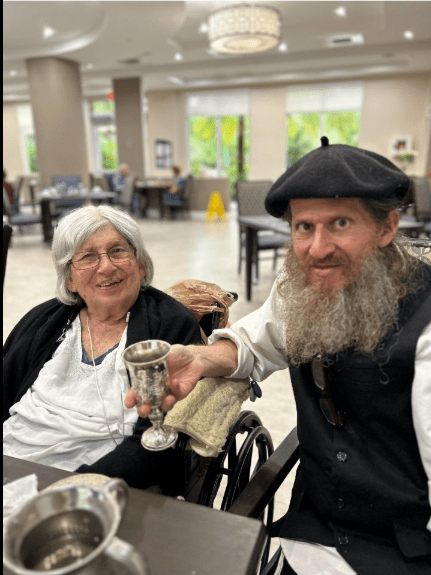
I have been a family caregiver for my mother for over a year now. Currently, I live with her as her caregiver 24/7 at The Club Assisted Living Facility in Boynton Beach, FL. I would like to provide a private aide for my mother, so that she can have some quality care, inasmuch that the facility does not offer care beyond basic tasks. Rather, my mother needs constant attention, that I have been giving without respite. Since I am with my mother throughout the day, and I also spend overnights here seven days a week, hiring a professional aide would also relieve the burden upon me. My mother is wheelchair bound. She has CHF (congestive heart failure), vascular dementia and polyosteoarthritis. My mother fractured her hip in February 2025, wherein she was in Rehab for six months before transitioning to assisted living. Many residents, especially the wheelchair bound have private aides here; my mother deserves the same.
Tiferes represents the ability to blend or harmonize opposites; thus, the strong-willed efforts to endure challenges in life, may require tenacity; yet, a measure of compassion for ourselves and others also plays a role. Endurance in regard to forbearance of others, is supported by compassion, mercy, and leniency towards others. Also, we would benefit from some show of compassion to ourselves, especially when our best efforts do not immediately amount to success. By acknowledging our mis-tries as stepping-stones, we can learn how to do better next time; this requires a certain amount of self-compassion, lest we judge ourselves too harshly for our failures.
The tenacity to endure the nisyanos (challenges) of our lives, especially when we are running low on reserves, may benefit from acknowledging that we are not superhumans; rather, we are beings built to be dependent on the earth, our fellow human beings, and G-d Himself. When we reach the point of exasperation, when we find ourselves barely able to cope, then we may note a sense of powerlessness. This is exactly when we should turn towards others for help; and, primarily, to accept that the only One who may be able to effect a situation from Above for the good, is the One who created the situation in the first place.
G-d has a divine plan for every individual; when we begin to see the challenges in our lives as tests that will bring us to the next level of spiritual improvement, then we may be in harmony with our circumstances, others, and G-d’s blueprint for our lives.
What foundation have I built in order to bring harmony, meaning, and an overall sense of peace into my life? Am I the sort of person that permits myself “to go with the flow,” in hope that if I trust in the Universe, everything will work out for the best? Or, do I have a set of tangible principles, rules, and guidelines in my life, that governs my lifestyle, so that I might decide how to respond to the events in my life, rather than letting them passively shape me? Am I able to make wise decisions, based upon higher truths? Or do I go with the whim of my feelings, letting my emotions rule me instead?
“Build Thou the walls of Jerusalem” (Psalm 51:20, JPS 1917 Tanach). The walls of our foundation that will preserve our inner sense of peace are the protective measures that we put in place to preserve our values, so that the sanctity of our lives is not diminished by outside factors. A strong foundation built upon wisdom is necessary, in order to navigate the challenges of life. From where is your harmony derived in your life? Upon what kind of foundation do you build your peace of mind? Do you have a lasting peace of mind? Is there something that will contribute to the restoration of your soul, when you might be thrown off balance by the world?
Harmony and inner peace must be maintained, through returning, and returning again, each and every day of our lives to our central focus in life. If our focus is on G-d, then true peace is attainable through His presence.
The middah (character trait) of gevurah may be expressed as a measure of strictness. Therefore, one way of conceiving of gevurah within chesed could have to do with applying a measure of strictness to the quality of kindness. Placing a limit on our kindness, in response to the awareness that not every situation is best suited to respond in kindness involves a dash of wisdom.
Therefore, chesed may require the use of discernment, in order to ascertain how much kindness would be appropriate to the situation. Boundaries are essential to the maintenance of identity. Where do I begin and the other person starts? This question must be regulated in real time by each and every individual. Being kind to others, without standing up for oneself simply amounts to people pleasing, at the expense of oneself.
There must be a healthy balance between chesed and gevurah, and sometimes the strictness of gevurah is necessary to restore a sense of self and integrity.
“See, I have placed before you this day life and good, death and evil.” – Deuteronomy 30:15
How can we freely choose, based on information that will permit us to make an informed decision? If we know right from wrong, then, we should have enough discernment to make the best decision for all who will be affected by that decision. Yet, if we lack discernment between right and wrong, and knowledge of good and evil, what precedent do we have to base our decisions upon? This is the tragedy of post-modern culture, that deprived itself of truth.
G-d is like a loving-parent, who sets clear boundaries and expectations with consequences for the child’s behavior. Out of the mouth of G-d proceeds the reward for doing good, and the judgments for wrongdoing (Lamentations 3:38). If we are unaware of G-d’s commitment to our moral condition, wherein He has made everything clear to us for our sake, then we are no better off than if we were in unchartered waters.
If we attempt to navigate life without a map, what can our decisions be based upon, except for subjective notions of right and wrong, that might be vague and ill-defined? The truths established in scripture are time-tested, and will not be undone by the attempt to undermine Western civilization today.
This has been going on for centuries, ever since the French Revolution and the Enlightenment. And, now, the cultural revolution that has captured the institutions of society is wreaking havoc upon classical Western values. Yet, the value of scripture, and the qualities that are promoted by its teachings, such as truth, forgiveness, and compassion are even more important now than ever before. Our humanity is at risk if we fail to embrace the virtues that make us human.
It is an illusion to think that we can leave our loved ones in the hands and expert care of professionals, who claim to offer services for the elderly. Admittedly so, this is a generalization; I am compelled to write about this issue, because my mother is in a less than ideal situation at a facility wherein she is on the independent living side of the facility at 82 years old, and clearly in need of more assistance than she is receiving there. The answer is not for her to transition to the assisted living side of the building; rather, her loved ones, including myself, should be at her side, throughout the day, guiding and comforting her.
People do not want to recognize the slow decline of life, inclusive of diminished abilities to function as one did in their younger years. We do not want to acknowledge that we age, as is natural, and enter a period of time, where we should be more focused on spiritual things, looking ahead to eternity. We are only concerned about material comfort, including that of our loves ones, as if we are absolved of our familial duties. So, my Mom is an independent living facility, losing her independence.
This is and has always been tragic – the slow and gradual shift away from family-centered life, to lives dependent upon our vocations, interests, and going our separate ways, all a part of the process of individuation, and finding “our place” in the world. Perhaps, if we have other means, we should not entrust our loved ones into the hands of professional corporations, who may not be as human-oriented as they could be, because after all it is a corporation with a bottom line. Love cannot be substituted for money as a motivating factor to treat human beings with compassion. And, I am as guilty as my brother and sister. And, we are all trying to make amends… somehow.
weekly Torah reading: parasha Ki Tisa 5783 – Compassionate Consideration
“And the L-RD passed by before him, and proclaimed: ‘The L-RD, the L-RD G-d, merciful and gracious, long-suffering, and abundant in goodness and truth: keeping mercy unto the thousandth generation, forgiving iniquity and transgression and sin.” – Exodus 34:6-7
H’Shem acknowledges the broken human condition of mankind; for we ourselves are shattered vessels, not unlike those that originally contained the divine light – a microcosm of the macrocosm. Therefore, He is merciful to potential sinners, even knowing that they will, indeed, sin. This act of compassion towards those who are prone to sin, denotes the mercy associated with His name. How could frail man be treated with ill intentions by the One Who is “Compassionate and Gracious, Slow to Anger, and Abundant in Kindness and Truth” (Exodus 34:6)?
Rather, let this serve as a model for us human beings, within the framework of our relationships to each other; for, we may learn to be tolerant of others, who we might otherwise despise, if we, regrettably took the stance of a haughty attitude towards them. Moreover, we do not know whether or not someone will engage in unlawful (sinful) behavior; therefore, we should not judge anyone who might seem inclined towards a less than godly life.
There is hope for all, including ourselves when we fall. For H’Shem is also “Forgiver of Iniquity, Willful Sin, and Error” (34:7). This is our reassurance, that when we are unfaithful to the stipulations of the Sinai covenant, H’Shem is still faithful to us. Like unto His forgiveness of B’nei Yisrael, regarding the golden calf debacle, in response to the compassion that Moses elicited from Him through his prayer on behalf of the people; this is also a model for us, to seek H’Shem’s forgiveness, when we fall prey to temptation. “Pardon our iniquity and our sin, and take us for Thine inheritance” (Exodus 34:9, JPS 1917 Tanach).
Shabbat shalom. If you appreciate this material, please consider contributing a few dollars to my Shabbos fund for wine & challah: tap here to contribute tsedokah
“No greenery remained on the trees or the grass of the field in the entire land of Egypt.” – Exodus 10:15
It is as if to say that Egypt was deprived of its finery. Later, the Egyptian people, who had developed a sense of respect toward the Children of Israel, gave them their silver and gold vessels, as well as fine garments; thus was Egypt depleted. This is metaphorically the effect of sin upon our lives, that the corruption within eventually takes on an outward appearance, diminishing our regality as beings created in the image of G-d. Additionally, the external manifestation of sin may appear in a way, and a measure, concomitant with the aveira (sin).
Consider that even though King David was forgiven for his transgression, he was still chastised as a measure of H’Shem’s attribute of justice. Lest we think that teshuvah is too easy of a way to wipe our sins clean, perhaps, like David, we are still chastised, yet, to a lesser degree than we would have been if we were obstinate to the point of not acknowledging our sins. One might say that this is an example of the dynamic interchange of mercy and justice, working in tandem with each other, to a greater or lesser degree; and, we hope that H’Shem will always sweeten the judgment against us, by way of showing His mercy toward us.
If you appreciate this post, and other writings at Tree of Life, please, consider contributing a few dollars to support my writing: tsedokah.
To get from one place to another, walking a fine line along the way, is not only a task enacted by a tightrope walker. In fact, I imagine that I will not be the only one attempting a “balancing act” this Purim: balancing joy & sorrow, past & present, and religion & life. Perhaps, there is no need for me to explain, and you, dear reader, are already beginning to get an inkling of what I am about to say. Purim is quickly approaching; yet, my thoughts are preoccupied with a modern-day Purim story, wherein the archvillain is intent on destruction, despite the opposition.
Abraham Heschel advocated for a Judaism that is not wrapped up in its past glory, in spite of the prevailing circumstances of life. How can I celebrate Purim in a joyous manner, knowing that a real-life situation demands my attention, prayer, and support? To go along with Purim-as-usual would create a great disconnect between what is meant to be a living faith in touch with the challenges of life and the actual challenges that present themselves, despite the timing.
The war in Ukraine will not be put on hold for the celebration of Purim. This is the stark reality that many of the Jewish refugees who have managed to cross the border know. And the unfortunate ones, who for whatever reasons are still in Ukraine, sheltering in basements, or fighting to defend their country also know this all too well. The rejoicing in Shushan and the lands of Ahasuerus did not occur until after victory was procured for the Jewish people, who were previously threatened by the evil designs of Haman.
Today, rejoicing over this past victory will in all likelihood be diminished in light of the present reality. Whatever lessons we are able to glean from Purim, I would encourage that these be applied to our response to the events of today. Otherwise, as Heschel wrote, we risk ignoring “the crisis of today,” “because of the splendor of the past” (Heschel, G-d in Search of Man, ch.1).


 The Tree of Life