
Everyday Avodah

motzei Shabbos shpiel for Shabbat Shuvah:

Avodah as an Everyday Intention (not only for the pious):

“And now, Israel, what doth the L-RD thy G-d require of thee, but to fear the L-rd thy G-d, to walk in in all His ways, and to love Him, and to serve the L-RD thy G-d with all thy heart and all thy soul.”

– Deuteronomy 10:12, JPS 1917 Tanach

According to Ramchal, the primary expectation of H’Shem is to serve Him with all our heart and soul. In other words, our avodah (service) towards H’Shem within the framework of our everyday lives is what counts the most in His eyes. It is written elsewhere, “Trust in the L-RD with all thy heart and lean not upon thine own understanding. In all thy ways acknowledge Him, and He will direct thy paths” (Proverbs 3:5-6, JPS 1917 Tanach). Thus, living in accordance with H’Shem’s intent for our lives goes well beyond observing Shabbos, giving tsedokah, and lighting Friday night candles.

Every facet of our lives should reflect the wisdom of G-d, bestowed upon us through His words. For, his wisdom is higher than ours, and his thoughts are not our thoughts (Isaiah 55:8-9). That is to say, that if our thoughts are not in accordance with the transcendent values that H’Shem would like to instill within us (see Jeremiah 31:33), then, we may unfortunately be led astray by a subjective rendering of value, derived from our feelings.

The current set of values being offered to society, proliferating to an accelerated degree, fosters subjectivity, while de-emphasizing objective reality. Additionally, when an entire society adopts a set of pseudo-values, then that society is no longer in accordance with G-d’s directive. How will the faithful be able to continue to walk in integrity? Our dependence on H’Shem is essential, despite whatever trajectory the world takes.

“Commit thy way unto the L-RD; trust also in Him, and He will bring
it to pass. And He will make thy righteousness to go forth as the light,
and thy right as the noonday.” – Psalm 37:5-6, JPS 1917 Tanach

Torah insight: Shoftim 5781

Deuteronomy 18:1

“The levitical priests, the whole tribe of Levi, shall have no territorial portion with Israel.”

Their presence was required at the Temple, even according to a designated rotation of shifts; moreover, they were scattered amongst the territories of the tribes, in order to attend to the spiritual needs of the entire people. Thus, in acknowledgment of their devotion to H’Shem, Maimonides speaks of the optional commitment that we may take upon ourselves, to become like unto “spiritual Levites.”

shiur Shemini 5781 – Serving with Reverence

B”H

shiur for parashas Shemini 5781

“This is it that H’Shem spoke, saying: Through them that are nigh unto Me I will be sanctified, and before all the people I will be glorified.”

– Leviticus 10:3, JPS 1917 Tanach

According to chazal, Nadav and Avihu are portrayed as righteous individuals who overstepped the boundaries in place for them as kohanim; as they tried to draw closer to H’Shem, in an unauthorized manner, they were consumed by “fire from before H’Shem” (Leviticus 10:2, JPS). According to the Talmud, Aaron’s two sons died, only for the sake of sanctifying H’Shem’s name (Zevachim 115b). Within the same Talmudic passage, another view expresses their deaths in a more nuanced way, specifically, alluding to their transgression, by making the point that they had previously been cautioned against drawing too close to H’Shem.

Rashi comments that through the execution of judgment upon righteous individuals, yiras HShem (fear of G-d) is brought upon the people. This is an important principle; with respect to Nadav and Avihu, their deaths caused the people to witness how precarious serving G-d may be, if a righteous person is not careful in respect to his avodah (service towards H’Shem). The deaths of Nadav and Avihu show, by way of an example with a deadly consequence, that H’Shem needs to be approached with great reverence, awe, and respect.

A harsher condemnation of Nadav and Avihu may be rendered by a perspective that is even more critical of their transgression. They brought “alien fire” from a source other than the fire on the mizbeach. The fire on the mizbeach had its origin from Shomayim (Leviticus 9:24); according to Sifre, fire descended in the shape of a pillar between heaven and earth. Yet, Nadav and Avihu flouted the implicit directive, to draw fire from the outer mizbeach for all of the offerings (the original fire from H’Shem).

What could have motivated Nadav and Avihu to take alien fire for their incense offering, instead of the fire that H’Shem had provided? One view critiques them as desiring to usurp the authority of Moshe and Aaron. Furthermore, because the authority of Moshe and Aaron was given to them from H’Shem, then flouting that authority would be akin to disregarding the authority of H’Shem. Therefore, it could be inferred that their taking of alien fire constitutes a betrayal of their motives to disregard the sovereignty of H’Shem.

Consider that towards the end of the first Temple period, the people were admonished, “they have forsaken Me, the fountain of living waters, and hewed them out cisterns for themselves, broken cisterns, that can hold no water” (Jeremiah 2:13, JPS). The people had sought out other gods – alien gods – to worship, according to their own intentions; they had forsaken H’Shem.

Today, when we approach H’Shem in prayer, our avodah (service), equal to prayer of the heart, should be performed in reverence. Serving H’Shem, through the observance of the mitzvot, as well as through prayer, may also require a rigorous examination of conscience, for the sake of bringing to light ulterior motives, faults, and character defects. Who shall ascend into the mountain of H’Shem? And who shall stand in His holy place? He that hath clean hands and a pure heart [lev tahor]; who hath not taken My name in vain, and hath not sworn deceitfully” (Psalm 24:4, JPS 1917 Tanach).

Chanukah Lights 5781

B”H

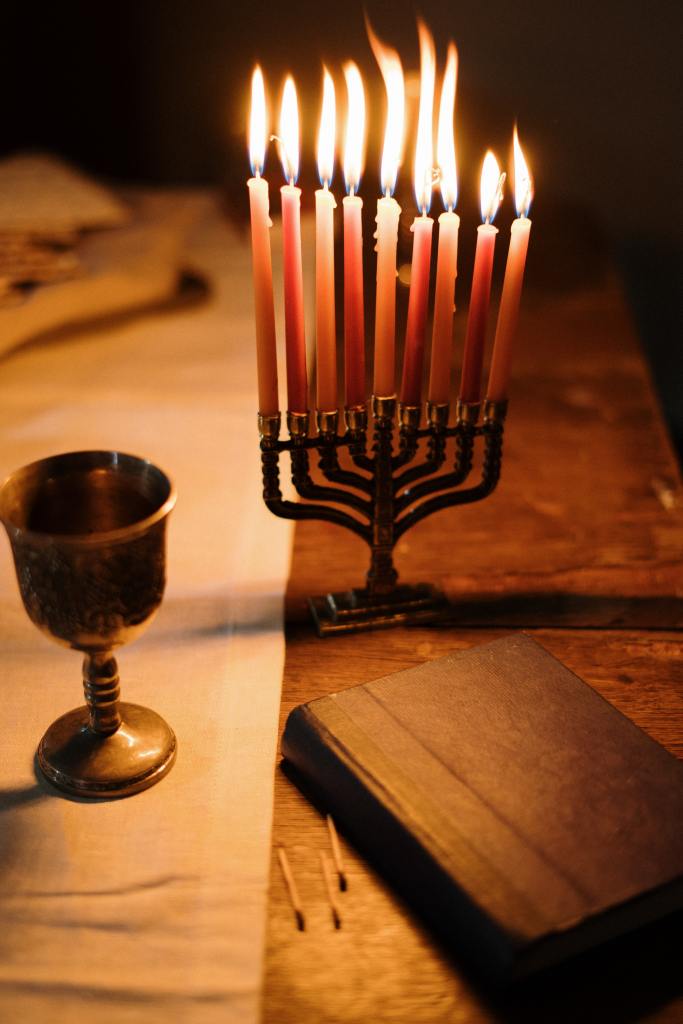
Photo by cottonbro from Pexels

erev 3 Teves 5781

erev 8th day Chanukah

Each day of the eight days of Chanukah, a candle is lit, successively, so that on the first day – one candle is lit, then two candles on the eve of the second day, and so on. Yet, if you look at a menorah designed for Chanukah, there are nine candle holders. (Unless the menorah uses oil with tiny wicks, then there are nine repositories for the oil). The reason for a total of nine, is to have a place, usually in the center of the menorah, for the shamash (servant) candle, that is used to light all of the other candles. This candle is lit first; then, it shares its light with the other candles.

The tradition is reminiscent of the pasuk (verse), “In Thy light do we see light” (Psalm 36:10, JPS 1917 Tanach). H’Shem is the source of life, that bestows light upon us; we are connected, ever dependent upon Him for every breathe we take. “For Thou dost light my lamp; the L-RD my G-d doth lighten my darkness” (Psalm 18:29, JPS). At the darkest time of the year, may we hope to be enlightened by H’Shem, by way of His emes (truth), and chesed (mercy), two key components of Chanukah; for His truth led us in the darkness against our enemies; and, through His mercy, we were spared from capitulation to the ungodly agenda of the opposing force, that tried to erase our belief and practice.