Omer: Day 49 Culmination

Malchut shebbe Malchut: Kingship within Kingship

Today’s middot (character traits) are malchut shebbe malchut (autonomy within sovereignty). This may be compared to the goal of self-actualization as found within a psychological framework. Finding a meaningful path to pursue in life will lead to personal fulfillment; in other words, the culmination of the soul’s mission in life. Under G-d’s directive, through His hasgacha peratis (divine guidance) that is placed upon us all, we are guided to what will steer us in the right direction.

In the Biblical sense, Solomon simplifies the essence, the underlying goal, to focus on, namely, “the sum of the matter, when all is said and done: Revere G-d, and observe His commandments; for this applies to all mankind” (Ecclesiastes 12:13, JPS 1985 Tanach). By staying on course, within the framework of G-d’s commandments, including all of the guidance that stems from them, one’s potential as an individual may be fully garnered, along the way towards the Kingdom.

The path is a unified one, inclusive of the soul in relationship to G-d. Moreover, to think in terms of self actualization, as well as directing ourselves to be in accordance with G-d’s expectations of us, is not incongruent. Although, in the strictest psychological sense, Maslow may have intended self actualization an expression of inner potential; within the light of a divine plan, it is ultimately through the negation of self to a higher cause, that the self may realize its fullest potential within G-d.

On Shavuot (the fiftieth day), the culmination of the forty-nine day journey through self renewal, by way of examining our character, reaches its goal. As the L-RD said to Moses, “when thou hast brought forth the people out of Egypt, ye shall serve G-d upon this mountain” (Exodus 3:12, JPS 1917 Tanach). We receive the Torah anew, in the very present moment of our lives. H’Shem willing, the refinement of our soul over the past seven weeks has brought us closer to the fulfillment of peace and wholeness in our lives.

“The path of the righteous is as the light of dawn, that shineth more and more unto the perfect day.”

– Proverbs 4:18, JPS 1917 Tanach

Lag b’Omer 5781

In light of the recent tragedy in Meron, at the Lag b’Omer celebration there, this essay is dedicated as memorial to those who perished, those who were injured, and those who are recovering from shock and ther psychological trauma after witnessing the event. Also, comfort and solace to those who are in bereavement; the families and friends of all who have suffered on this day. Usually, an auspicious day, honoring R’Shimon bar Yochai, the reputed author of the Zohar, the event turned tragic after the collapse of a structure, where some were celebrating. Full details are not available at this time.

Lag b’Omer is the 33rd day of the counting of the Omer – the 49 day period between Passover and Shavuot. The day has several clear historical references, most significantly, being the day that the plague that took 24,000 of Rabbi Akiva’s students ceased. With his five remaining students, he began again to promote Torah instruction to his students, including Shimon bar Yochai. The message being that because the reason given for the plague is the baseless dissension amongst the students, the importance of respect towards others who have differing opinions and viewpoints, inclusive of various interpretations should be respected, despite the differences. A timely message for today’s world.

It is proclaimed by the most devoted advocates of the Zohar that the author of the premier mystical literature of Judaism is indeed R’Shimon bar Yochai. Yet, not everyone agrees with this claim; in particular, from a scholarly perspective, the work has been shown to have been written by Moses de Leon of Spain. When the Aramaic writing is deciphered according to its grammar and other idiosyncracies, these have much in common with the grammatical structures and manner of conveying ideas at the time and place that Moses de Leon lived. Additionally, there is testimony from that time, that indicates he wrote the work, yet because of his own relative obscurity, assigned the authorship to Shimon bar Yochai to bring an air of authenticity to the writing.

Shimon bar Yochai, according to a reference in the Talmud lived in a cave for many years, in order to escape persecution by the Romans. When he left the cave, he is given almost supernatural powers in the Talmudic account, as if he acquired these during his meditations in the cave. A likely story that was later developed into a greater myth by the author of the Zohar, assigning the mystical treatise itself to his authorship. Yet, any astute reader can note that the “companions” of the character, Shimon bar Yochai in the accounts given over in the Zohar are historical personages whom did not even live during the same time span as each other. Yet, they all gather around Shimon bar Yochai as if they are alive and well, irrespective of when they actually lived.

While it is true that the Zohar does contain many ideas, teachings, and Torah gems not generally found in more traditional works, these mysteries of Torah are revealed by the actual author based upon his knowledge of prior mystical treatises. So, perhaps, it may be considered as a moot issue, who the author of the Zohar is, if indeed it’s words help to further understand the secrets of Torah.

On the other hand, it is a concern of my mine, that Shimon bar Yochai is described as a holy lamp, subsequently elevated as the chief expositor of the mysteries of Torah, when some of what is conveyed in the Zohar are foreign to Torah, Tanach, and Talmud, such as gilgulim, transmigration, and the error of reincarnation. The specific teachings in regard to reincarnation do not bring light into the world; rather, they cast a shadow of darkness upon the truths of Torah. Moreover, the concept of reincarnation detracts from the clear understanding having to do with the Tehillas HaMeisim (resurrection of the dead). Whereas, the soul is restored to the body and we are judged according to how we lived this one life that we are all given.

Furthermore, glorifying Shimon bar Yochai seems to detract from the expectation of the prophet, Eliyahu HaNavi revealing the secrets of Torah, upon his return. Incidentally, since the prophet ascended into Heaven on a chariot, his return would not be counted as reincarnation. Additionally, the role of the Messiah in part is to bring to light the essential Torah truths for the generation that will see his crowning as King in Jerusalem, at the beginning of the the sabbatical millennium, when G-d’s Kingdom is ushered into existence.

Ad mosai – how long until the fallen sukkah of David is restored?

“In that day will I raise up the tabernacle of David that is fallen, and close up the breaches thereof, and I will raise up his ruins, and I will build it as in the days of old.”

– Amos 9:11, JPS 1917 Tanach

Omer: Day 28 Whose Narrative Will You Follow?

Malchut shebbe Netzach: Kingdom within Endurance

The attribute of malchut may also be rendered as sovereignty, or autonomy.

Where within the quality of endurance, may autonomy be found? How does a sense of self, and personal motivation contribute to one’s endurance in the face of challenges? How much can we rely on our own autonomy, without seeking guidance from a Higher Authority? Reflect on these questions for yourself. Each person’s answer will be uniquely tailored to that person’s experience, belief, and values.

Scripture indicates that G-d would like us to be dependent upon Him, rather than see ourselves as completely independent. Yet, the more we depend upon Him, the less need there will be to depend upon others. Therefore, ironically, we become more self-sufficient in the eyes of others, who are not aware of the source of our strength. Therefore, it may be said that endurance may occur not only through our own efforts, but through a concomitant focus on G-d.

My own sense of autonomy is rooted in G-d’s authority; then, I will never stand alone, when facing the challenges of my life. Moreover, in confrontation with others, I can rest assured, that as long as I am in right relationship with G-d, He will support me, when faced with adversity. Trusting in His sovereignty means that I can trust in the values, inculcated by scripture.

Ideally, there should be no need for me to waver, in favor of an alternate set of values being promoted by anyone who claims to know better. This is not arrogance on my part. Rather, if I humble myself to G-d’s sovereignty in my life, then I do not speak on my own behalf. Whereas society would like to claim the right to decide on the narrative norm, it has already been engraved in stone, and spoken by the mouthpieces of G-d’s spokespersons, as recorded in scripture.

Chanukah Lights 5781

B”H

Photo by cottonbro from Pexels

erev 3 Teves 5781

erev 8th day Chanukah

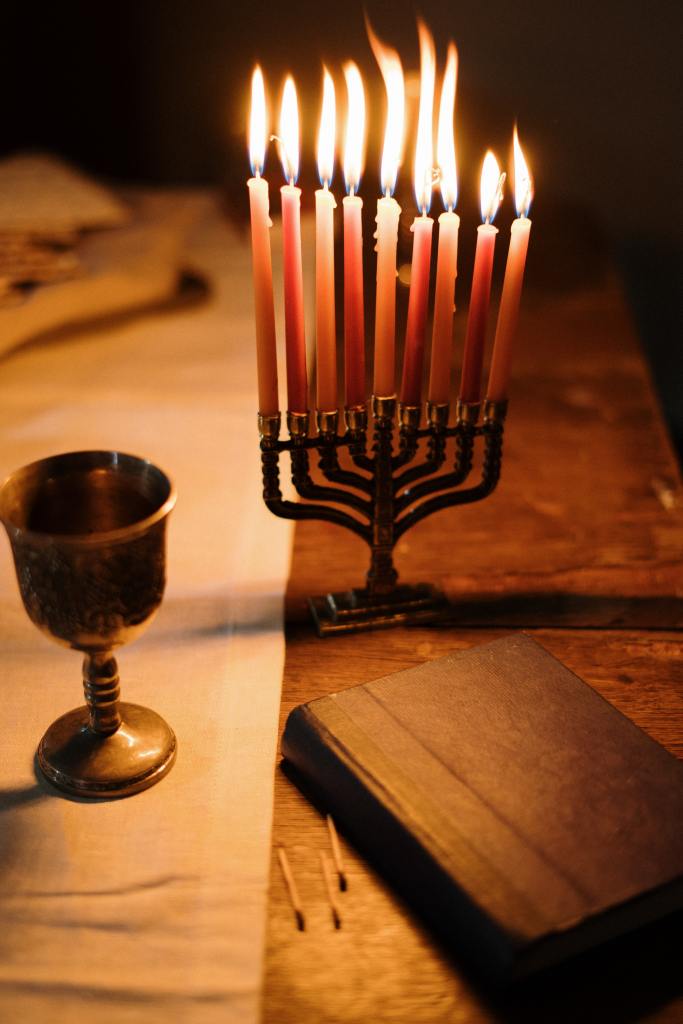
Each day of the eight days of Chanukah, a candle is lit, successively, so that on the first day – one candle is lit, then two candles on the eve of the second day, and so on. Yet, if you look at a menorah designed for Chanukah, there are nine candle holders. (Unless the menorah uses oil with tiny wicks, then there are nine repositories for the oil). The reason for a total of nine, is to have a place, usually in the center of the menorah, for the shamash (servant) candle, that is used to light all of the other candles. This candle is lit first; then, it shares its light with the other candles.

The tradition is reminiscent of the pasuk (verse), “In Thy light do we see light” (Psalm 36:10, JPS 1917 Tanach). H’Shem is the source of life, that bestows light upon us; we are connected, ever dependent upon Him for every breathe we take. “For Thou dost light my lamp; the L-RD my G-d doth lighten my darkness” (Psalm 18:29, JPS). At the darkest time of the year, may we hope to be enlightened by H’Shem, by way of His emes (truth), and chesed (mercy), two key components of Chanukah; for His truth led us in the darkness against our enemies; and, through His mercy, we were spared from capitulation to the ungodly agenda of the opposing force, that tried to erase our belief and practice.