Pick a Word, Not a Fight

“A word fitly spoken is like apples of gold in settings of silver”

– Proverbs 25:11, JPS

Raise me up above my thoughts, so that I do not equate ideas with personhood. We are more than our beliefs, ideologies and political views. Perhaps, if more of us realized this, rather than falling prey to the unspoken adage, “the personal is political,” the world would be less divisive. A word well-chosen is better than an onslaught of personal opinions, or flow of ideological ideas. A barrage of convictions held, delivered as a statement of faith, may truly get the point across to another person who holds different views; however, this does no make for good conversation, nor bridging the divide between the entrenched positions have lurking below their personas.

I, myself, and included as one who needs to hear these words, written partly from personal experience, as well as from an understanding gained through what others have recommended for the sake of conversations. Meeting another person where he or she is at is crucial. Although, sometimes, I have to backtrack in a conversation, and explain directly that I’d rather learn more about the other person’s viewpoints than espouse my own, I am making my way closer the better conversation. Sometimes silence for the sake of peace is the best remedy.

Yet, when, it is more a matter of defending truth, especially that of the existence of G-d and the authority of scripture, as well as the actuality of Biblical events, like the revelation on Mount Sinai, I can hardly keep silent. For the sake of conscience, I must speak my mind, as well as a deterrent against being influenced by the words of others, intended to undermine my own faith. Yet, can I do any of this with a smile on my face, and compassion in my heart toward the other? It is challenging to maintain a balanced approach to open and honest communication, for sure.

©2024 Tzvi Fievel all rights reserved

Omer Count: Day 27 – Foundational Truths

Yesod shebbe Netzach: Foundation of Victory

How well am I able to maintain an active participation in the foundational truths of my life? Do I only have an intellectual understanding of those truths? Or, am I able to ground those truths within the framework of my everyday life? Moreover, when faced with challenges, within and without, how well will that foundation prove to support the overall structure of my belief and practice?

The stronger my foundation, the greater my ability to endure the storms of life. If my foundation is like a house built upon a rock, then it will be more secure than a foundation built upon sand. A solid foundation is one that will withstand the changing seasons, because the underlying principles are founded upon timeless truths. Yet, a foundation built upon the shifting sands of societal norms will not last. Without a firm foundation we will sink into this quagmire of confusion. Without building blocks that will provide a sure foundation, a structure built upon empty truths, ultimately, will not be established.

The measure of strength of a foundation may very well be its resistance to change; therefore, only time-tested truths will ultimately prevail. The establishment of any foundation that is not in accord with those truths will ultimately fail to provide the shelter that only can only be provided through what is Heaven sent.

Day One: Light & Darkness

cultural confusion in the modern world

From the beginning of the creation of the world, G-d used His discernment, to separate the light from the darkness. This separation is a phenomenon that we may observe every day at dusk and dawn. The transition at twilight into nighttime, and at sunrise into daytime.


The Targum Neofiti emphasizes that G-d separated by word between light and darkness. We take the separation of light and darkness as a natural occurrence that seems effortless on the part of what most human beings refer to as nature.

Since there was no Biblical Hebrew word for nature, modern Hebrew uses the word Teva. The point that I would like to make is that the initial separation was not effortless, nor a natural phenomenon; rather, it was a principle of separation built into the fabric of Creation.


According to Rashi, because the light was good, it was not appropriate “that light and darkness should function together in a confused manner” (commentary on Genesis 1:4, sefaria.org). A parallel can be drawn to moral sphere, wherein the same rule may apply.


This tenet would caution us against the mixture of light and dark in our thinking, and how we approach the challenges in life; it may help decrease the confusion prevalent in society today. The current chaos of the world derives from the admixture of good and evil that permeates society. It is fueled by the flames of bitterness, animosity, and hostility.


Yet, the line of good and evil runs through the heart of every human (Solzhenitysn). This must be acknowledged by all decent people with a conscience in order to maintain a balanced perspective. The designation of people groups leads to an us and them mentality, as if the moral integrity of the in-group compels them to be sinless in their own eyes.

On the contrary, we must examine ourselves, all the moreso, in order to better challenge evil. In a world where the difference between good and evil is blurred we need the discernment that is able to separate light from darkness.  “The words You inscribed give light” (Ps. 119:130, JPSN).

©2024 all rights reserved

Challenging the Polarities

I am an introvert; however, I am not shy. There is a difference between introversion and shyness. While shy people would like to be able to socialize with others, yet, find this challenging, introverts are not inclined to socialize with others, yet, can do so when necessary. So, I have no anxiety around conversing with others, when engaging in conversation beyond the usual small talk that people make. And, I have even become more open to speaking with others.

With this in mind, I showed up at a local pro Palestinian protest at a university campus as a peaceful counter presence, intent on conversing with anyone who was receptive to converse with me. After the protest, while the protesters were still present, I was talking with several pro-Israel students, when one of the co founders of the university SJP club approached me and introduced himself. We conversed for about ten minutes.

Additionally, I met a Jewish student who viewed Israel disfavorably; yet, we were able to connect as fellow Jews. This only goes to show that divisions can be crossed, rifts can be mended, and the impossible become possible. This is only the start for me with similar endeavors, as I plan to show up at a panel discussion next week, sponsored by the SJP university club.

This is not something that I would recommend for anyone. For myself, I have a strong background of understanding within the framework of the pro-Israel stance that I uphold. Moreover, I am somewhat familiar with the history of the Israeli-Palestinian conflict going back at least to 1935. Historical context is important, because most of the lies have sprung up irrespective of the historical facts.

In engaging in conversation with anyone about this conflict, it is important to know how to recognize false narratives that might challenge the truth. So, before I attend the panel discussion, I will continue to educate myself, in order to strengthen my stance. HaShem willing, something positive will result from the breaking down of walls that separate.

©2024 all rights reserved

Truth Must Prevail

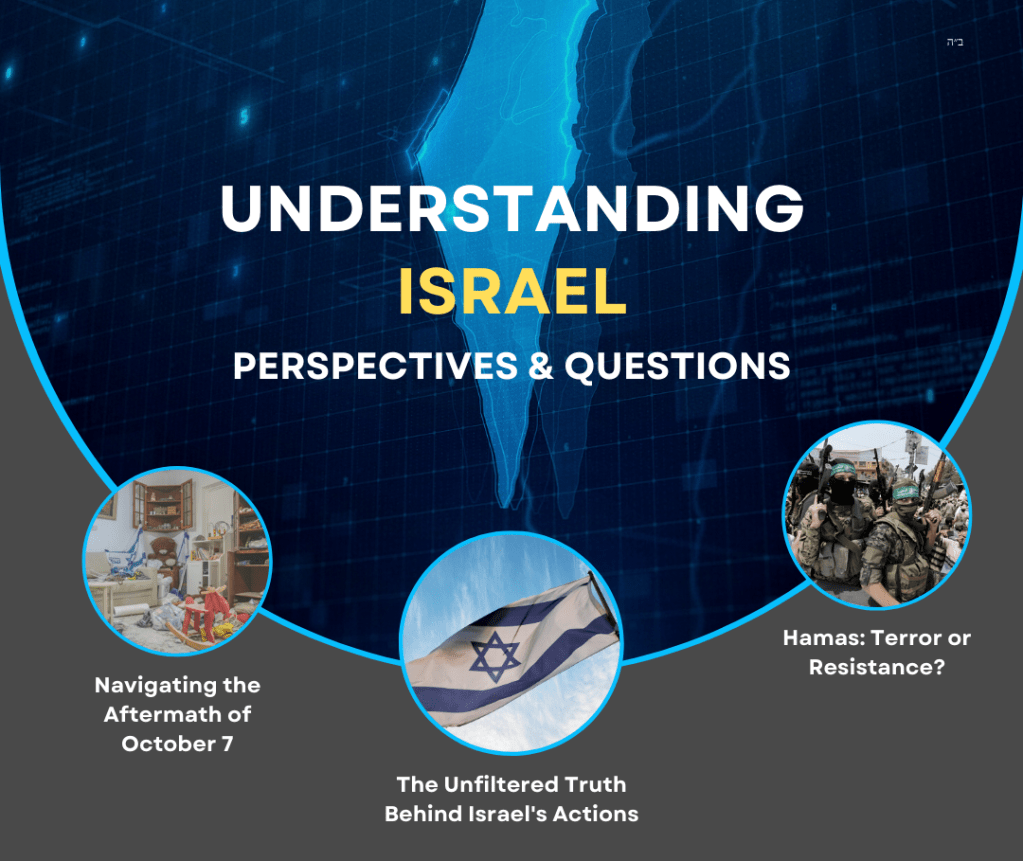
In regard to the Understanding Israel presentation, the event went well. At least two people, who had been leaders of the protest in town over the weekend, were at the presentation; they each identified themselves, while asking a question, during the question and answer part of the event. One of them did try to make his own points, before asking a question; however, he was reminded that it was questions only.

There were two moderators, and six panelists: five were Jewish, one was a Christian pastor. After the panelists answered the questions, a news video was shown of an interview with the Son of Hamas, who is an ex-member of Hamas that speaks out against Hamas. He is very pro-Israel, as well as concerned for the Palestinian people. 

As soon as the video started, the two activist leaders got up, as well as about a dozen people sitting in the back of the lecture hall (also identified as activists by their talk amongst themselves) who walked out. Although, three of the activists remained, including one of the leaders. It’s like they know that the Son of Hamas, who spoke in the video, speaks the truth that they did not want to hear.

At least, none of the activists disrupted the presentation. (There had been 3 or 4 police officers there, as well as a security detail just in case). Since the activists were there for the entire presentation, before the video, I hope something that was said may have made an impression on some of them. 

After the presentation this evening, I reflected more on what occurred. I asked myself why did several activists remain? Two of the activist leaders got up as soon as the video began, as well as about a dozen activists sitting in the back. Yet, three activists remained, including one of the leaders.

I think that this was planned ahead of time, inasmuch that the leaders signaled the others to leave, perhaps, seemingly as a walk-out protest against the video; yet, more likely, so that the regular activists – underlings – who left, would not be influenced by the words of the Son of the Hamas. In other words, the leaders had the other members of their group leave to prevent them from hearing the truth. That is my analysis.

Yet, there were at least several people in the audience who asked more sincere questions that were responded to by the panelists with the truths that revealed the overall reality of the conflict. I think these, apparently Non-activist students in the audience are more likely to have their hearts changed by the truth.

The following video is the complete panel discussion:

Pray for the Captives


Thus saith the L-RD: even the captives of the mighty shall be taken away, and the prey of the terrible shall be delivered; and I will contend with him that contendeth with thee, and I will save thy children.”

– Isaiah 9:25, JPS 1917 Tanach

Embracing Virtue

weekly Torah essay: parasha Nitzavim-Vayelech 5783

“See, I have placed before you this day life and good, death and evil.” – Deuteronomy 30:15

How can we freely choose, based on information that will permit us to make an informed decision? If we know right from wrong, then, we should have enough discernment to make the best decision for all who will be affected by that decision. Yet, if we lack discernment between right and wrong, and knowledge of good and evil, what precedent do we have to base our decisions upon? This is the tragedy of post-modern culture, that deprived itself of truth.

G-d is like a loving-parent, who sets clear boundaries and expectations with consequences for the child’s behavior. Out of the mouth of G-d proceeds the reward for doing good, and the judgments for wrongdoing (Lamentations 3:38). If we are unaware of G-d’s commitment to our moral condition, wherein He has made everything clear to us for our sake, then we are no better off than if we were in unchartered waters. 

If we attempt to navigate life without a map, what can our decisions be based upon, except for subjective notions of right and wrong, that might be vague and ill-defined? The truths established in scripture are time-tested, and will not be undone by the attempt to undermine Western civilization today.

This has been going on for centuries, ever since the French Revolution and the Enlightenment. And, now, the cultural revolution that has captured the institutions of society is wreaking havoc upon classical Western values. Yet, the value of scripture, and the qualities that are promoted by its teachings, such as truth, forgiveness, and compassion are even more important now than ever before. Our humanity is at risk if we fail to embrace the virtues that make us human.

Woke Dynamics

Religious Parallels:

Religion contains the opportunity to recognize sin, through a careful examination of the heart; upon doing so, an individual can be reconciled to G-d, by confessing those sins. Wokism has defined its own version of sins, through a social justice framework. By way of coercion, a person may be brought to confess his or her so-called sins.

In order to better recognize this parallel within the Woke system, it is helpful to look at the specific elements that contribute to this dynamic. Generally, cancel culture is relentless, and does not give opportunity to confess; typically, there is no allowance for mercy and compassion; rather, only judgment and condemnation.

Yet, calling out another person’s microaggression, can require that person to publicly confess, wherein there is a type of confession made for the “sin” of microaggression. That person, as a result of the confession, is then figuratively reinstated to the good graces of the community wherein the microaggression was committed.

1). it reinforces the system, wherein blame is placed upon an individual regardless of intent 2). confession is an admittance of guilt, whether or not the statement condemned as a microaggression was intended as a slight or not. 3). the process actively engages the so-called culprit of the microaggression to be further indoctrinated into the overall system. 4). accusing someone of a microaggression can lead to censorship of that person’s speech.

Any allowance for redress within the Woke system is nil. The opportunity for discussion about the issues at hand does not exist, because the Woke always reason that they hold the moral position, based upon their set of rules.

Extracting a confession brings the condemned person over to the other side, absolving him or her of his so-called sin. An effort may be made to bring the individual into further alignment with the ideology.

As a result of a foot-in-the-door tactic, a confession allows for entrance into that person’s psyche. Woke pseudo-moralism is intrusive; understanding the dynamic behind the language is key, so as to not fall prey to its influence.

©2023 all rights reserved

Truth & Knowledge

The Importance of Transcendent Values

“Whoso loveth knowledge loveth correction.”

– Proverbs 12:1, JPS 1917 Tanach

The knowledge acquired from kitvei kosdesh (holy scripture) shows us how to conduct our lives, and leads to improvement in the areas of our lives that need to be brought into alignment with G-d’s will. Yet, by way of contrast, the current zeitgeist of the world advocates for subjective experience, thoughts, and feelings over and against any kind of objective, authoritative, or transcendent knowledge.

Moreover, when an individual person is regarded as the soul arbiter of truth, self raises itself above all else, and closes one’s mind toward correction from any other source. The result being that a wayward freedom reigns in the heart, instead of a higher calling of responsibility. We are not only responsible to ourselves; we are also responsible to others and to G-d. Even if we are unable to steer the world in a direction that is in accord with truth and knowledge, let us, at least, reclaim whatever parts of ourselves need to be brought under the directive of G-d’s will.

The adage, “to they own self be true,” not only falls short of the mark (an archery metaphor); the adage also furthers the subjective self-indulgence of the heart that leads to confusion. As the world spins, metaphorically, in the wrong direction, those who seek to uphold objective truth and values, must be true to a transcendent calling.

©2023 all rights reserved

post Shavuot reflection 5783

As we descend from Sinai, after the receiving of the Torah anew in our lives, may we be compelled to reflect upon our experience, and bring the light and wisdom of the Torah forward with us day by day.

May H’Shem grant us the discernment to apply these teachings to our everyday challenges, and spread the light throughout the mundane as well as the sacred times. That all truth may flourish above and beyond the lies.

©2023 all rights reserved