Omer: Day 19 Hod shebbe Tiferes – A Sure Peace

Hod shebbe Tiferes: Splendor within Beauty

(Otherwise rendered as humility within harmony).

Thus, one “role” of acquiring humility, in relationship to “peace of mind” is as follows: Humility may serve to temper a false sense of harmony within, by compelling a soul to recognize that any sense of inner peace is often fragile, especially if that peace is not drawn from a higher source. Are we willing to admit to ourselves, that we are dependent on many circumstances, needs, and expectations to maintain a sense of peace? To think otherwise may be an overestimation of one’s own ability to secure sure peace of mind with self and others.

Yet, if we would like to be able to transcend our dependence on the requirements that we set for ourselves, in order to bring us a peace that may actually be a fragile peace, then, through recognition of our limitations to secure this peace, we may humble ourselves before G-d, in acknowledgment of the everlasting peace that can provided through Him. “The L-RD will bless His people with peace” (Psalm 29:11, JPS 1917 Tanach).

Omer: Day 18 Netzach shebbe Tiferes – Centering

Endurance within Beauty

(Otherwise rendered as endurance within harmony). The center will not hold: my sense of balance will be thrown off, if my center is predicated strictly upon a sense of self. Rather, a transcendent focus will support a sense of balance, by way of transcending ourselves, so that a higher perspective may be gained. Victor Frankl explains that a greater sense of fulfillment than our own selfish pursuits must ensue from “one’s personal dedication to a cause greater than oneself or as the by-product of one’s surrender to a person other than oneself” (Frankl, Man’s Search for Meaning).

The ego thrives on pride, and a sense of accomplishment attributed to the efforts made by oneself. Yet, because we are limited beings, this kind of image, focused only on self will not endure. True harmony within may only endure through help from Above; otherwise, the weight of our own worries and concerns in this world, may become overwhelming. For myself, I would overestimate my own sense of self importance, if I thought that I could rely on my own moral, emotional, and intellectual reserves.

Because we are interdependent human beings, our lives are dependent on various factors, and the contributions of others, as well as our familiar and social connections. Therefore, we are somewhat dependent, to a greater or lesser degree, on others outside of ourselves. Ultimately, from the point of view of scripture, G-d would like us to depend on Him. “Cast your burdens upon the L-RD, and He will sustain you” (Psalm 55:23). For, His ways are higher than our ways, and His thoughts are higher than our thoughts (Isiah 55:9). Therefore, G-d may serve as a prolific resource.

note: These are my personal reflections on the implications of today’s combination of middot (character traits). These reflections are not meant to be comprehensive, inasmuch that they are not based upon any one particular system. Nor, may these ideas be characterized as authoritative, because I profess to being a student, not a teacher. I hope to inspire others to delve into an exploration of their own personality, for the sake of tikkun hanefesh (rectification of the soul).

Omer: Day 17 Tiferes shebbe Tiferes – Back to the Garden

Tiferes shebbe Tiferes: Beauty within Beauty

The epitome of beauty that speaks of harmony and balance within all of creation was present in the beginning within Gan Eden (the Garden of Eden). That harmony was disrupted, when Adam and Chava (Eve) partook of forbidden fruit from the Tree of Knowledge of Good and Evil. Up until that moment, the progenitors of humankind lived in a nondual world of blissful connection to G-d. Their relationship to Him was whole, and immersed in complete Oneness. They were at one with each other, and all of creation as well. Subsequent to their disobedience, the world became an admixture of good and evil.

Throughout history, these two forces often appeared in sharp outlines, discernible even to the casual eye, as well as the more carefully honed conscience. Today, the blur between good and evil that seems to have proliferated in the twentieth century is increasing to the point of concern, whereas the boundaries are no longer clearly marked in society. The prophet’s words apply, “woe unto them that call evil good, and good evil; that change darkness into light, and light into darkness; that change bitter into sweet, and sweet into bitter” (Isaiah 5:20, JPS 1917 Tanach).

The words of singer songwriter, Joni Mitchell, during the tumultuous 60’s still ring true, “We’ve got to get ourselves back to the Garden.” How so? Through bringing compassion towards a disharmonious world, beginning with ourselves. For G-d primarily expects His crowning achievement (humankind) to live lives that reflect His image. Mankind has fallen far since the days of yore; yet, recovery for the soul is still possible. With a sincere effort, a response will be elicited from Above.

note: These are my personal reflections on the implications of today’s combination of middot (character traits). These reflections are not meant to be comprehensive, inasmuch that they are not based upon any one particular system. Nor, may these ideas be characterized as authoritative, because I profess to being a student, not a teacher. I hope to inspire others to delve into an exploration of their own personality, for the sake of tikkun hanefesh (rectification of the soul).

Omer: Day 16 Gevurah shebbe Tiferes

Gevurah shebbe Tiferes: Power within Beauty

Strength must be modified, in order to be compatible with a specific end in mind. For example, gevurah as a measure of judgment in the form of an admonition, should be balanced by tiferes, for the sake of harmony in accord with the given situation. By way of analogy, opening a tin of sardines does not require as much strength, as prying open a car door with the jaws of life. So, it follows that correcting a student’s mistake in pronunciation, is less demanding than chiding a teenager for misbehavior. Every situation of admonition requires a unique degree of expression of gevurah.

Ona another note, for the sake of tikkun hanefesh (rectification of the soul), we should judge ourselves in a manner that is not too harsh, nor too lenient; rather, in way that would prove to be of the most benefit to the soul. Thus, a balance is necessary, in regard to how critical a person is of him or herself. A certain amount of positive self-talk will compel a person to feel encouraged: yet, it is also necessary to critique thought, speech, and action, in hopes of being able to improve any faults in these areas.

Precisely because we are human beings, we may improve upon ourselves, by way of transcending any negative characteristics. Ultimately, harmony within the framework of mind, body, and spirit will lead towards the ability to excel in accordance with the design given to us by the Creator. Abraham Twerski points out that human spirituality is dependent upon the distinguishing characteristics of humans that make them different than animals.

These would include free will, i.e., volition, inclusive of the ability to use discernment, delay gratifications,and put others ahead of oneself in certain situations. Achieving harmony within ourselves sometimes requires prioritizing our needs,in favor of higher, more noble aspirations. The discernment of gevurah will assist on the road towards freedom from our lower nature, The heights of spirituality rest upon the decisions that we make for ourselves, that are most in accord with being truly human.

note: These are my personal reflections on the implications of today’s combination of middot (character traits). These reflections are not meant to be comprehensive, inasmuch that they are not based upon any one particular system. Nor, may these ideas be characterized as authoritative, because I profess to being a student, not a teacher. I hope to inspire others to delve into an exploration of their own personality, for the sake of tikkun hanefesh (rectification of the soul).

Omer Day 15

chesed shebbe tiferes: Love within Beauty

The quality of loving-kindness expressed in a harmonious manner as represented by tiferes is integral to lending a helping hand in time of need. True kindness is not measured, per se, by any limiting factors; yet, flows outward from a place of sincerity, knowing how to quench the emotional thirst of others, like a river following its natural course. Even so, the natural expression of loving-kindness is rare, especially when almost everyone’s source of inner kindness is being tested by trying times. Therefore, finding the right measure of kindness at the appropriate time, in harmony with the specific needs of others requires discernment.

If we are in harmony with ourselves; then we also need to be kind to ourselves. To some degree how we treat others, may actually be reflecting how we treat ourselves. The commandment to “love your neighbor as yourself” (Leviticus 19:18) is considered a cornerstone of Jewish thought, through which all of the other commandments must be viewed. In respect to chesed shebbe tiferes, loving-kindness within harmony, the flowing out of love from a balanced place within an individual, can help to temper our efforts to do mitzvoth (good deeds), by tinging all that we do with a certain amount of kindness. In this manner, harmony may be either created or restored by always “keeping chesed in mind.”

Note: These are my personal reflections on the implications of today’s combination of middot (character traits). These reflections are not meant to be comprehensive, inasmuch that they are not based upon any one particular system. Nor, may these ideas be characterized as authoritative, because I profess to being a student, not a teacher. I hope to inspire others to delve into an exploration of their own personality, for the sake of tikkun hanefesh (rectification of the soul).
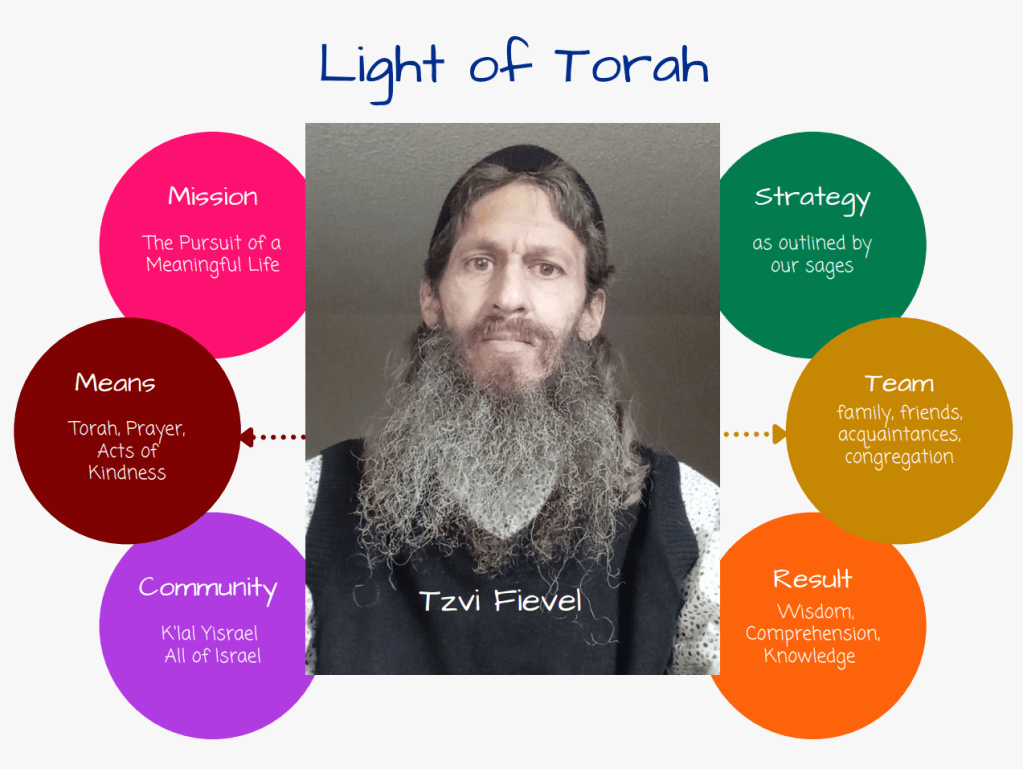
on a personal note:

I am at my desk, nearly twenty-four hours a day, for I often fall to sleep at my desk. Yet, the time has arrived for me to question my motives, and activities. What do I do? Mostly I think, read, and write about G-d, religion, and scripture. However, this will not suffice. For, I have very little lived experience in actually serving G-d within the framework of an active compatible community. To what avail have I been attending services on Shabbos on a regular basis? Virtually none, for the pace of service is too fast for me to meaningful follow along. The interruptions and chatter are always present to some degree; and, additionally, there is no fertile opportunity for me to foster any sense of kavannah before during or after the service. Moreover, seudah (lunch) after services, is disappointing as well, even though at times, I do get to here an interesting dvar. Even so, mostly, the table(s) are full of mundane chatter about worldly topics, forbidden to speak about on Shabbos.

And, so, at my desk shall I remain until I am able to find another community for myself, according to H’Shem’s directive. Baruch H’Shem (Praise G-d), for taking me this far on the journey. As usual, I will need to move on at some point, perhaps, in the near future; that is to say, that it is typical in my life to change, and need to find somewhere else where there is “room to grow.” For now, I will take a break from attendance at the local shul where I have been davening in-person on Shabbos and holidays. After all, I still have the shul I attend on Zoom during the weekdays, as well as on Shabbos, early in the morning, inasmuch as I give myself a dispensation to do so, being that it is forbidden to use the internet on the Sabbath. It figures that all of these thoughts are preceded by my first ever purchase of a bottle of unkosher wine on Friday afternoon (under extenuating circumstances); perhaps, the treif wine has made my brain “loopy,” so to speak; although I feel as if I am “liberated” from the minutia of details, that plague the mind of an observant Jew. So be it, for now. I will remain on the derech (path); yet, I will tread mindfully as I walk along to eternity.

note: this blogpost was posted exactly at the end of Shabbat, erev 30 Nissan 5782.

motzei Shabbos: Acharei 5782

The Death of the Righteous Serves as Atonement

At the beginning of parashas Acharei, the Torah briefly mentions the deaths of two of Aaron’s sons, Nadav and Avihu, whose lives were taken by the L-RD, when they approached near to Him (Leviticus 16:1). Immediately afterwards, the H’Shem commands, in regard to Aaron, “that he not come at all times into the the holy place within the veil, before the ark-cover which is upon the ark; that he die not; for I appear in the cloud upon the ark-cover” (Leviticus 16:2, JPS).

The juxtaposition of this admonition alongside the mentioning of the deaths of Nadav and Avihu hints to one reason why they were consumed by fire: H’Shem’s warning to Aaron, not to enter at all times, implies that Nadav and Avihu made an unbidden entry into the Holy of Holies, for which their lives were taken. “The L-RD thy G-d is a devouring fire” (Deuteronomy 4:24, JPS).

Next, the Torah begins to relate the various details of the Yom Kippur service: “Aaron shall come into the holy place” (Leviticus 16:3). Only the Kohein Gadol could enter the Kadosh Kadoshim (Holy of Holies), and only on one day of the year, the Day of Atonement. The Sages ask, why are the deaths of Nadav and Avihu are juxtaposed with the Yom Kippur service: In like manner that the Yom Kippur brings atonement, so does the death of the righteous also bring atonement” (Yerushalmi Yoma 1:1). Even though Nadav and Avihu were consumed, the Torah credits them as righteous (Leviticus 10:3), because of their intentions to draw close to H’Shem. So, the juxtaposition of their deaths with the Yom Kippur service points toward the understanding that the death of the righteous atones for sin.

The nature of atonement may be better understood in light of the following commentary: “For the life [nefesh, soul] of the flesh [basar, body] is in the blood; and I have given it to you upon the altar to make atonement for your souls; for it is the blood that maketh atonement by reason of the life” (Leviticus 17:11, JPS 1917 Tanach). Rashi comments on ci nefesh habasar, “for the life of the flesh” of every creature, “not only of animals brought as sacrifices, is dependent on its blood (badahm hiy), and it is for this reason that I have placed it [on the altar] to make expiation for the life of man: Let life come and expiate for life” (Rashi, commentary on Leviticus 17:11, sefaria.org).

Omer: Day 14 Malchut of Gevurah

sovereignty within strength

Wielding power from a position of authority requires discernment. The autonomy of the sovereign must reflect his own deference to G-d, for no one is above the law. Moreover, the sovereign must respect the autonomy of his subjects; and, not rule in a manner that diminishes their individuality and rights. Every human being is granted a certain amount of autonomy from Above. If G-d gives us free will, then we must also recognize the autonomy of our fellow human beings. Regardless of the worlds demands upon the souls of individuals to conform to the “narrative norm,” the individual of integrity must seek inner liberty.

Omer: Day 13 Yesod of Gevurah

foundation within strength

The foundation of strength, from an integral standpoint, has to do with “moral constraint.” Gevurah is also associated with judgment; therefore, judging ourselves within the context of our foundational beliefs may compel us to see if we “measure up” to the standards that we would like to uphold in our lives. A proper assessment of our foundational strengths is necessary to test the integrity of the overall “structure” – the beliefs and presuppositions that our lives are based upon.