
The Sweetness of Torah

Sweeten the words of Your Torah in our mouth.

– Blessings of the Torah

What was once pleasant, has become unpleasant. The wisdom of the Torah has given place to the wisdom of the world, without any recourse to the truths of our ancestors. Rather, for many amongst the children of Seth in the diaspora, the traditions of Judaism may still flourish, yet, without the substance. If we only knew what we were missing, we would pray, “sweeten the words of your Torah in our mouth.” In other words, we would feel compelled to learn of the words and instructions of Torah, to the extent that they would appeal to our sense of priorities, and what is important in our lives. Rather than rejecting them as passe, unenlightened, or contrary to our progressive sensibilities, we would yearn to receive them, if only G-d would somehow cause us to appreciate their flavor, taste, and essential ingredients.

We have forsaken “the fountain of living waters,” and constructed “cisterns, broken cisterns, that can hold no water” (Jeremiah 2:13, JPS). When we thirst for something more constant in our lives to bring us peace, contentment, and lasting joy, we turn elsewhere, without realizing that only pure water from the Source of all that exists can supply us with any refreshment of lasting value. And, still, we yearn for something more than the ephemeral pleasures of life. For G-d has planted eternity in the heart of mankind, so that we might seek to know Him beyond time and space. Only a transcendent G-d, Who is able to transcend our own understanding, can give us anything of lasting joy in this world and the World-to-Come. His wisdom, contained in Torah, within the narratives of creation and fall, the lives of Abraham, Isaac, and Jacob, Joseph and the Exodus, plus the giving of the Torah at Sinai, and all of the commandments are rich in value.
poem: Plight

There is no time to dawdle,

as the wind picks up speed.

Securing a place in line for ourselves,

once we get to the border is tantamount

to reserving a place for ourselves

in the ledgers of the Book of Life.

Little one, when you place

one foot in front of the other,

know, that each step along the way

will bring you closer to safety.

For, the past will not follow you

through the checkpoint into your future.

Your brothers and sisters,

aunts and uncles, all of your cousins,

and friends are also on this journey,

upon the long and winding road

to freedom from fear, harm, and hunger.

All that is required of you,

amidst the explosions and turmoil,

the deafening sounds inside of the cities,

and the rising tides of world war

is a steadfast faith in your plight,

knowing that G-d is watching

over you, until the end.

Entering the Cloud

weekly Torah reading: parashas Vayakhel 5782

  “Then the cloud covered the tent of meeting, and the glory of the L-RD filled the tabernacle.” – Exodus 40:34, JPS 1917 Tanach

H’Shem’s Presence appeared to B’nei Yisrael, before they crossed the Sea of Reeds; at that time, H’Shem’s presence was manifest in the form of the cloud, and the pillar of fire. At Sinai, H’Shem’s Presence was accompanied by thunder and lightning (Exodus 19:18). And the cloud rested atop Sinai: “‘Lo, I come unto thee in a thick cloud, that the people may hear when I speak with thee’” (Exodus 19:9, JPS).

When Moshe was on Sinai with Aaron, Nadav and Avihu and the seventy elders of Israel, (see 24:9), he was called by H’Shem, “Come up to Me into the Mount and be there; and I will give thee the tables of stone,” and thus, “Moses entered into the midst of the cloud.” (24:18). R. Bachya explains that just as he was called to go into the cloud of H’Shem’s glory at Sinai, the only way he could enter the sanctuary when the cloud of glory filled the sanctuary was when H’Shem would first call to him (40:34, sefaria).

Consider that to a certain extent, a parallel lesson can be drawn from this reading, wherein we too will find that as we approach H’Shem, the way may be obscured by His glory, like the cloud atop Sinai and within the Mishkan (Tabernacle). We may find that we are not able to draw any closer to Him than we are at current, until He calls us from within the obscurity of our understanding. Then, we may enter a cloud, so to speak, of initial unknowing (like leaving our comfort zone) that will eventually bring us to a greater understanding.

Reflections on a Bris

It’s the middle of the week, two days after Chanukah, one day after the memorial of my father’s transition, according to the Gregorian calendar. I attended a bris this afternoon at the local shul. While standing silently in the last row of a small sanctuary, during the proceedings, with the sunlight streaming through the windows, and the pensive quality of my thoughts, it seemed as if angels were gathered at this auspicious moment. Otherwise, since I had awoken at 1:00 a.m. this morning, and only dozed off for a brief rest at my desk, later in the morning, perhaps, because of lack of sleep, my imagination took flight and fancy, within the realm of the spiritual.

When the infant was named, seemingly so, after a prominent rebbe, I thought of the continuity of tradition across the generations. How my own great great grandfather, who my father is named after, studied under a Chassidic rabbi in Poland, Rabbi Perlow, who passed away in 1943. And, so, not only was the Chassidic heritage broken when my great grandfather immigrated to the U.S.; rather, also, that specific line of chassidism was interrupted; although, Rabbi Schneebalg continued the line of Bolechover Chassidism into the current century. Regardless, the personal connection for me is one only recently resurrected, so to speak, in the dark recesses of my mind, where memories persist, despite the conflagration of the Shoah.

When the infant was ceremoniously brought into the sanctuary, he was placed on a white pillow, wrapped in a bundle, and carried by the presiding rabbi. This occurred after everyone present was asked to stand, and remain standing for the entire proceedings. How apropos, I thought, for the infant to be honored as if being brought as an offering unto H’Shem; for, surely, the intent is for the newly born member of the Jewish people to “offer himself” as a soul committed to the observance of G-d’s commandments in every aspect of his life; and, he will be brought up with that intent. Within the framework of the religious family that he was born into, the customs of our ancestors are preserved, in addition to G-d’s commandments.

Camping with the Angels

motzei Shabbos: parashas Vayeitzei 5782

“And Jacob went on his way, and the angels of G-d met him. “And Jacob said when he saw them: ‘This is G-d’s camp.’ And he called the name of that place Mahanaim.” – Genesis  32:2-3, JPS

An impasse was reached in the life of Jacob after his encounter with Laban at Mitzpah. This might also be thought of as a brief moment of respite, between the danger that had passed, regarding the threat of Laban, and the impending encounter between Jacob and Esau. After making a covenant with Laban to guard against future infringements against either of their sense of autonomy (Genesis 31:52), Laban departs, returning to his place, after having pursued Jacob, who, himself is on his way back to his father Isaac, bringing along with him, his wives and children. The Torah records, immediately following his treaty with Laban, that angels of Elokim (G-d) met him; so, he ascribes the name mahanaim to that place.

Literally, mahanaim means two camps; commentators note that this implies that two camps of angels met with Jacob. The first camp of angels were those that had accompanied him along the way from Laban’s land, where he had lived for twenty years; the second camp of angels are said to be those who will now accompany him into Eretz Canaan. Another rendering may be made as follows: that in the plain sense, perhaps, the name mahanaim refers to the two camps that met immediately preceding the appearance of the angels. That is the camp of Jacob and his family, who had set out to return home; and, the camp of Laban and his men, who pursued Jacob when he learned that he fled.

Where they actually met, and made a covenant after the confrontation, is referred to as Mitzpah, meaning “watchtower.” This place is mentioned later in kitvei kodesh (holy scripture) and seems to have continued to be a type of boundary marker between two peoples, the Israelites and the Ammonites. Thus the presence of the angels may concern the peace that is hoped to ensue after narrowly averting a potential conflict. Either way, in a more general sense, another implication may be the reassurance from G-d, that he watches over us in times of trouble, as he watched over Jacob. “For He will give His angels charge over thee, to keep thee in all thy ways” (Psalm 91:11, JPS).

“This heap is witness between me and thee this day. Therefore was the name of it called Galeed; and Mizpah, for he said: ‘The L-RD watch between me and thee, when we are absent one from another.”

– Genesis 31:48-49, JPS 1917 Tanach

The Foundation Stone

“And he lighted upon the place, and tarried there all night, because the sun was set; and he took one of the stones of the place, and put it under his head, and lay down in that place to sleep.”

– Genesis 28:11, JPS 1917 Tanach

The word lighted, “and he lighted upon the place,” in Hebrew is vayifgah, from the shoresh (root word), paga. According to chazal, the word implies prayer; hence, the origin of the evening prayer being attributed to Jacob. Therefore, this event in Jacob’s life was the precedent for prayer, the third prayer of the day, that marks the transition from day to night.

What significance does this particular prayer serve? Within the context of the evening shema, the prayer draws emphasis to G-d’s faithfulness to Israel; we remind ourselves of His faithfulness to us, because darkness signifies the exile; yet, He is with us, as He was in the past: “In all their affliction He was afflicted” (Isaiah 63:9).

The stones that Jacob placed around his head, twelve stones, are said in the midrash to have been taken from the mizbeach (altar) made by Abraham. The next morning, Jacob “took the stone that he had put under his head, and set it up for a pillar” (Genesis 28:18). In other words, of the twelve stones that he originally placed under his head he took the stone, one specific stone. Although, according to the midrash, symbolically, the twelve stones became one, representing the unity of the twelve tribes of Israel.

According to Pirkei de Rabbi Eliezer, this stone was given the name evehn shetiyah (the foundation stone), many generations later. This stone symbolizes the center of the world, from where all the earth was created. Jacob poured oil on this stone, so that it could be used as a mizbeach (altar), later, when he would return from his journey to Haran. This location is where the first and second Temples stood, many generations after Jacob. It is also where the third Temple will be built in Jerusalem.

As mentioned above, the maariv (evening) prayer, recited after nightfall, is a reminder of H’Shem’s faithfulness to us, during this Galus, i.e., the current exile. With our hope focused on the time of the Final Redemption, we may look forward to the time when K’lal Yisrael (All of Israel) will be united. “And He will set up an ensign for the nations, and will assemble the dispersed of Israel, and gather together the scattered of Judah” (Isaiah 11:12, JPS 1917 Tanach).

“‘Not by might, nor by power, but by My spirit, saith the L-RD of hosts. He shall bring forth the top stone with shoutings of Grace, grace upon it.’” – Zechariah 4:6-7

Prayer Ladder

parashas Vayeitzei 5782

“And he dreamed, and behold a ladder set up on the earth, and the top of it reached to heaven; and behold the angels of G-d ascending and descending on it.”

– Genesis 28:12, JPS 1917 Tanach

Prayer is a means of communication, between man and G-d – a connection between earth and heaven. The gateway to G-d’s abode in Heaven was revealed to Jacob. “And, behold, the L-RD stood beside him, and said; ‘I am the L-RD, the G-d of Abraham thy father, and the G-d of Isaac. The land whereon thou liest, to thee will I give it, and to thy seed” (Genesis 28:13). In addition to this promise, H’Shem also reassured Jacob, that He would safeguard him, and bring him back into the land (Genesis 28:15).

The place of Jacob’s revelation was none other than the place, mentioned earlier in Torah, where Abraham brought up Isaac as an offering. Mt. Moriah, the place where Isaac was bound, is also where Jacob dreamt of a ladder reaching towards Shomayin (Heaven). When he awoke, he said, “this is none other than the house of G-d, and this is the gate of heaven” (Genesis 28:17, JPS 1917 Tanach).

Rashi comments, based upon Pirkei DeRabbi Eliezer, on the verse, and this is the gate of heaven, a place where prayers would ascend to heaven (sefaria.org). Jacob saw angels of G-d ascending and descending upon the ladder in his dream. The question may be asked, if these are angels of G-d, why are they first ascending and then descending? One response, according to Sforno, is that these angels ascending towards Heaven represent prayers, and the angels that are descending from heaven represent the answers to those prayers.

Additionally, the place where Jacob dreamt of the ladder, Mt. Moriah is also where the Beis HaMikdash (Temple; literally, House of the Sanctuary) was eventually built in Jerusalem. Genesis Rabbah comments that the Heavenly Temple is directly above the earthly Temple, therefore the temple in Jerusalem served as the gateway to the Heavenly Temple (Genesis Rabbah on Genesis 28:17).

Today, it is still acknowledged that all of our prayers ascend to Heaven from the Temple Mount in Jerusalem. R. Bachya notes that the word zeh (this), as in this must be the gate of heaven, occurs three times in the passage, an allusion to the three Temples. The first and second Temples were destroyed; yet, we await the rebuilding of the third Temple, and the era of peace that will be brought with the establishment of Malchus Elokim (the Kingdom of G-d).

Baruch shem k’vod malchuso l’olam va’ed.

Blessed be the name of His glorious kingdom forever.

deveykus

When merged

within the singsong chant

of a chassidic melody,

the congregant’s souls become one

for a brief moment, encapsulated

by the deveykus (connection)

to G-d that is fostered

by the unity.

~~~~~ ~~~~~

The sway

of the congregants

while davening (praying),

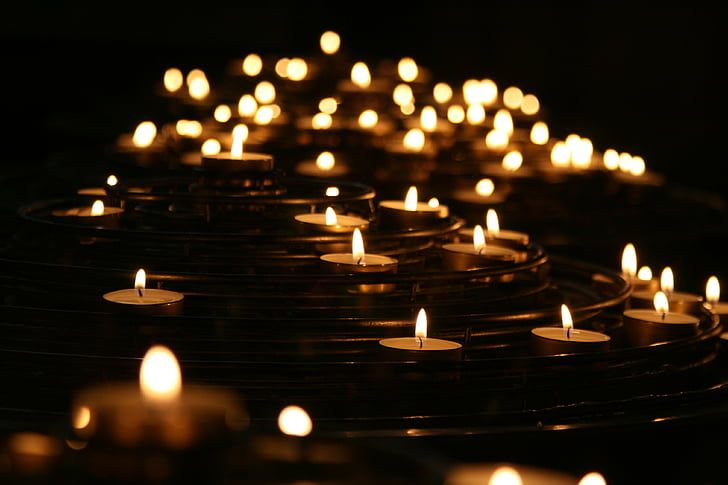
like flickering flames on candles,

reaching toward heaven,

assist the soul’s yearning

for deveykus (connection).

Tradition & Remembrance

Halloween, traditionally known as All Hallow’s Eve was originally a solemn vigil that preceded All Hallow’s Day (All Saints Day) on November 1st. Although, apparently, there were pagan origins to the day itself, before the Church’s innovation, for Western civilization in Europe, the day connoted respect for the dead, within a traditional Christian framework. Therefore, having superseded the pagan origins, the intent was to prepare for the remembrance of the saints the next day, as well as all of the departed souls, remembered on All Soul’s Day (November 2nd). It was believed that prayers could be offered on behalf of the dead who were in purgatory, that they might eventually be freed in order to make their ascent to Heaven.

In the Jewish tradition, we have nothing of the sort on this day that is reckoned according to the Gregorian calendar. Rather, we have Yizkor, and other traditions to commemorate our loved ones who have passed away. Yet, there are some striking similarities, if I dare to mention some of them. When we say the kaddish prayer, in particular, this is a prayer that specifically praises G-d, and does not mention death at all. Because the dead can no longer perform mitzvoth (good deeds), we say prayers on their behalf, so to speak, to bring them closer to G-d; thus, I believe that even if they are in Gehenna, their souls may benefit for the good. When lighting a yahrzeit (memorial) candle, on the anniversary of the death of a loved one, a traditional prayer requests an aliyah (ascent) for the soul of the one who has passed away. Respect for the dead is of the utmost importance in Judaism.

prayer: Intentional Focus

Prayer is meant to be self-reflexive. For, how can the prayers truly benefit the soul, unless the meaning of the prayers is known to the person who is praying? Yet, there is a belief that praying in Hebrew, regardless of knowledge of the Hebrew language, also benefits the soul. While it may be the case that the soul benefits, this could be at the expense of the individual’s actual understanding of the words. Rabbi Nachman of Breslov, the founder of Breslov Chasidism advocated the need to pray in one’s own language. I find this approach refreshing, inasmuch that he understood the importance of kavanah (intention) at the level of praying in a meaningful way.

Moreover, not only pray in one’s own language, at least for some of the prayers, but to be able to comprehend the meaning of the words one prays is important. Words have meaning in and of themselves; a dictionary is a handy guide to those meanings when unsure of what a word conveys, or how it is used in a sentence. However, the words of kitvei kodesh (holy scripture) have meaning above and beyond the words themselves, and must be understood within the greater context of the themes of the biblical narratives they portray, as well as their theological significance.

The siddur (prayer book) has been described as an overall composite of what is most significant in Judaism. The prayers are an active means for inculcating the values, traditions, and beliefs of Judaism into our lives. As such, the siddur should garner our greatest attention, and praying should not end up being a rote experience, performed without true intention or understanding. If our prayer experience is dry, then we need to somehow make amends.

One way to do so is to increase a sense of kavanah (attention; intentional reading) through specific techniques designed for this purpose. For example, if praying too fast, one way to slow down is to pause, every time the name YHVH is written, otherwise denoted by the words H’Shem or  L-RD. This serves to develop a pace whereby reflection becomes possible, by paying more attention to the words that are being prayed. This is davening with kavanah, when the words have a direct and immediate impact on the soul of the individual praying.

It is of paramount importance to seek understanding of the meaning and significance of the words that are being prayed. Each individual should decide for him or herself, what language to pray, and how to find a healthy balance between Hebrew and one’s own language. The original Hebrew prayers are established by chazal (the sages) and should not be changed; at least not to the extent that they are unrecognizable in an English translation, or seem to abandon the original intent. For, the ultimate goal is to connect with H’Shem at the level of one’s own understanding and comfortability.