
Prayer Ladder

parashas Vayeitzei 5782

“And he dreamed, and behold a ladder set up on the earth, and the top of it reached to heaven; and behold the angels of G-d ascending and descending on it.”

– Genesis 28:12, JPS 1917 Tanach

Prayer is a means of communication, between man and G-d – a connection between earth and heaven. The gateway to G-d’s abode in Heaven was revealed to Jacob. “And, behold, the L-RD stood beside him, and said; ‘I am the L-RD, the G-d of Abraham thy father, and the G-d of Isaac. The land whereon thou liest, to thee will I give it, and to thy seed” (Genesis 28:13). In addition to this promise, H’Shem also reassured Jacob, that He would safeguard him, and bring him back into the land (Genesis 28:15).

The place of Jacob’s revelation was none other than the place, mentioned earlier in Torah, where Abraham brought up Isaac as an offering. Mt. Moriah, the place where Isaac was bound, is also where Jacob dreamt of a ladder reaching towards Shomayin (Heaven). When he awoke, he said, “this is none other than the house of G-d, and this is the gate of heaven” (Genesis 28:17, JPS 1917 Tanach).

Rashi comments, based upon Pirkei DeRabbi Eliezer, on the verse, and this is the gate of heaven, a place where prayers would ascend to heaven (sefaria.org). Jacob saw angels of G-d ascending and descending upon the ladder in his dream. The question may be asked, if these are angels of G-d, why are they first ascending and then descending? One response, according to Sforno, is that these angels ascending towards Heaven represent prayers, and the angels that are descending from heaven represent the answers to those prayers.

Additionally, the place where Jacob dreamt of the ladder, Mt. Moriah is also where the Beis HaMikdash (Temple; literally, House of the Sanctuary) was eventually built in Jerusalem. Genesis Rabbah comments that the Heavenly Temple is directly above the earthly Temple, therefore the temple in Jerusalem served as the gateway to the Heavenly Temple (Genesis Rabbah on Genesis 28:17).

Today, it is still acknowledged that all of our prayers ascend to Heaven from the Temple Mount in Jerusalem. R. Bachya notes that the word zeh (this), as in this must be the gate of heaven, occurs three times in the passage, an allusion to the three Temples. The first and second Temples were destroyed; yet, we await the rebuilding of the third Temple, and the era of peace that will be brought with the establishment of Malchus Elokim (the Kingdom of G-d).

Baruch shem k’vod malchuso l’olam va’ed.

Blessed be the name of His glorious kingdom forever.
deveykus

When merged

within the singsong chant

of a chassidic melody,

the congregant’s souls become one

for a brief moment, encapsulated

by the deveykus (connection)

to G-d that is fostered

by the unity.

~~~~~ ~~~~~

The sway

of the congregants

while davening (praying),

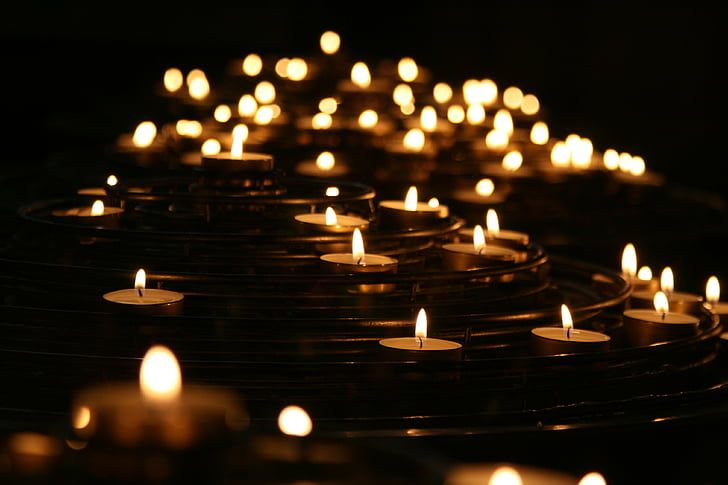
like flickering flames on candles,

reaching toward heaven,

assist the soul’s yearning

for deveykus (connection).

prayer: Intentional Focus

Prayer is meant to be self-reflexive. For, how can the prayers truly benefit the soul, unless the meaning of the prayers is known to the person who is praying? Yet, there is a belief that praying in Hebrew, regardless of knowledge of the Hebrew language, also benefits the soul. While it may be the case that the soul benefits, this could be at the expense of the individual’s actual understanding of the words. Rabbi Nachman of Breslov, the founder of Breslov Chasidism advocated the need to pray in one’s own language. I find this approach refreshing, inasmuch that he understood the importance of kavanah (intention) at the level of praying in a meaningful way.

Moreover, not only pray in one’s own language, at least for some of the prayers, but to be able to comprehend the meaning of the words one prays is important. Words have meaning in and of themselves; a dictionary is a handy guide to those meanings when unsure of what a word conveys, or how it is used in a sentence. However, the words of kitvei kodesh (holy scripture) have meaning above and beyond the words themselves, and must be understood within the greater context of the themes of the biblical narratives they portray, as well as their theological significance.

The siddur (prayer book) has been described as an overall composite of what is most significant in Judaism. The prayers are an active means for inculcating the values, traditions, and beliefs of Judaism into our lives. As such, the siddur should garner our greatest attention, and praying should not end up being a rote experience, performed without true intention or understanding. If our prayer experience is dry, then we need to somehow make amends.

One way to do so is to increase a sense of kavanah (attention; intentional reading) through specific techniques designed for this purpose. For example, if praying too fast, one way to slow down is to pause, every time the name YHVH is written, otherwise denoted by the words H’Shem or  L-RD. This serves to develop a pace whereby reflection becomes possible, by paying more attention to the words that are being prayed. This is davening with kavanah, when the words have a direct and immediate impact on the soul of the individual praying.

It is of paramount importance to seek understanding of the meaning and significance of the words that are being prayed. Each individual should decide for him or herself, what language to pray, and how to find a healthy balance between Hebrew and one’s own language. The original Hebrew prayers are established by chazal (the sages) and should not be changed; at least not to the extent that they are unrecognizable in an English translation, or seem to abandon the original intent. For, the ultimate goal is to connect with H’Shem at the level of one’s own understanding and comfortability.

motzei Shabbos: Sukkot Chol haMoed 5782

And Rabbi Ḥiyya bar Abba also said that Rabbi Yoḥanan said: Had there been left open a crack so much as the size of small sewing needle in the cave in which Moses and Elijah stood when G-d’s glory was revealed to them, as it is written: “And it shall come to pass, while My glory passes by, that I will put you in a cleft of the rock” (Exodus 33:22), and: “And he came there to a cave…and, behold, the L-rd passed by” (I Kings 19:9–11), they would not have been able to endure due to the intense light that would have entered that crack, as it is stated: “For no man shall see Me and live” (Exodus 33:20).

– Megillah 19b; sefaria.org

Reflections: Yom Kippur 5782

Staying Aloof During the Neilah Service

Trying to make the best of the moments, in retrospect, that was my intent while perusing the prayers in English, and remaining focused on the words, while the Hebrew was being sung, mostly by the Rabbi and chazan (cantor). So, on the one hand, the tunes are potent with emotion; on the other hand, even if I know the song, I prefer to read the English, since I can only pronounce the Hebrew, without knowing the meaning.

Only the jokes were distracting to me; even as I recognize their told for the bulk of the congregation, who need to be kept entertained. Yet, for anyone like myself, who is there in all sincerity, the jokes are irrelevant. Moreover, on Yom Kippur, especially during the part of the service, before the final al chet (penitent prayers), jokes seem entirely contradictory to the type of mind-set required at that point.

However, I somehow managed to stay aloof, in my own space, and continue to foster some sense of kavannah (intention) that reflected the appropriate mood. This was rewarding – thank G-d, because in the past I would only get frustrated. Yet, there are always tradeoffs in life; so, I decided to make the best of the situation, despite the style of service not meeting my selfish demands.

L’shannah tovah. Next year in Jerusalem.

shabbos reflection: Tu b’Av

eruv Tu b’AV (fifteenth of the Hebrew month of Av)

This evening begins the lesser known Jewish holiday of Tu b’Av. Most of us are familiar with the 9th of Av, that occurred last week, commemorating the destruction of both the first and second Temples. Contrary to the mournful tone of Tish b”Av, the holiday of Tu b’Av (15th of Av) is a joyous holiday, a welcome change to the mournful Three Weeks that led up to Tish b’Av.

What does the holiday of Tu b’Av commemorate? According to some sources, all of the firewood necessary for the offerings of the new year was gathered by this day. Additionally, this day is when the men courted the women, in an outside gathering. Many Jews today pray for shidduchim (a marriage arrangement) on this particular day, because the day is considered auspicious to receive a favorable reply from H’Shem.

Omer: Day 34 Tragic Lessons

In light of the recent tragedy at Meron, due in part to overcrowding, I would like to recount some insightful renderings made by others, concerning what can be learned from this tragedy. Any tragedy must be viewed as a significant event, meant to bring us to a greater understanding of ourselves, the condition of the soul, and a greater awareness of our connection to G-d. The insight is not my own, rather it is based on a few responses, given by certain authorities within the rabbinic world as well as a few other reputable sources.

A key thought to keep in mind, is that nobody is immune from judgments that are brought upon us as a people. Teshuvah (repentance) is first and foremost the primary response, in order to acknowledge that could have been us, if things were different. It is meaningful to do teshuvah, in respect to this tragedy, because this will place our response in the proper context, knowing that this is a wake up call to make heshbon hanefesh (an account of the soul) by examining our conscience.

The point was made by another source in the Jewish world, that Rabbi Akiva’s students, almost two thousand years ago suffered a high mortality rate due to a plague, attributed to their inability to respect each other’s viewpoints, thus showing a lack of respect towards each other. Showing respect to others is a basic quality that should be considered as part of our humanity.


It was mentioned that the type of overcrowding that leads to a neglect of acknowlegding the physical boundaries of others has been evident at other events of a similar nature. The worst case scenario of this kind of neglect has tragically occurred; as a result, to make this tragic event meaningful would include, not only doing to teshuvah for the sake of our own souls; also, to consider our own awareness of the physical space we give to others, respecting their boundaries. Of course, if I may add to this, the greater task at hand would be to also respect other people’s emotional and psychological boundaries.


I would not be writing any of this, except to reiterate as respectfully as possible, points already made by others much more qualified than me to make such statements. However, I will conclude with an attempt to connect the the attributes of the day to these lessons. Perhaps, one of the foundations of humility is to recognize that we all share a common humanity with each other. When we see ourselves, more or less on the same level as everyone else, then we will not try to lift ourselves up above others in any manner whatsoever. Thus, we would not disrespect others in our own attempts to fulfill mitzvoth (commandments) or minchagim (customs). Every mitzvah should be performed with the following commandment in mind, “to love our neighbor as ourself.”

Please, pray for healing of all those who suffered from this tragedy. The wounded, as well as the first responders who dealt with the psychological trauma of witnessing the aftermath. Also, for the consolation of the bereaved families and friends of those who lost their lives in Meron. Thank you very much. And, may G-d bless all of us in our endeavors to excel at improving ourselves.

shiur: Pesach 5781 – the Seventh Day

B”H

Shiur for the Seventh Day of Pesach 5781

“And Moses said unto the people: Fear ye not, stand still, and see the salvation of the L-RD, which He will work for you to-day; for whereas ye have seen the Egyptians to-day, ye shall see them again no more for ever.”

– Exodus 14:13, JPS 1917 Tanach

As the Egyptian army approached, Torah records that B’nei Yisrael, encamped near the Sea of Reeds, cried out to H’Shem in great fear (14:10). Commentary notes that the people were divided in their response: 1). Some cried out to H’Shem in prayer, akin to the later writing of the psalmist, “Some trust in chariots, and some in horses; but we will make mention of the name of the L-RD our G-d” (Psalm 20:8, JPS). 2). Another group of the people, having great trepidation about their circumstances, took the exact opposite approach, expressing their regret for having left Egypt, and complaining to Moshe (see Exodus 14:10-12).

When Moshe responded to the consternation of B’nei Yisrael, in light of their present circumstances, despite the seemingly near danger that was imminent, he said to them, “Fear ye not, stand still and see” (see above). Or HaChayim comments, that the words “stand still” convey the essence of prayer, a reliance on H’Shem, turning to Him in the midst of nisyanos (trials). H notes that the same Hebrew phrase is used in the Tanach, in regard to the prayer of Hannah, Samuel’s mother, who prayed in all sincerity to H’Shem. The picture derived from this understanding is one of a people’s reliance on H’Shem, in hope of seeing His salvation at a time of great need, when Pharaoh’s army was bearing down upon them.

That night, an angel of H’Shem protected the people from the Egyptians, a cloud darkened the Egyptian camp, while a pillar of light shined upon the B’nei Yisrael. Moshe stretched his hand over the sea; and, H’Shem caused the sea to part by way of a strong east wind. The Children of Israel passed through the sea; however, when the Egyptians pursued them, Pharaoh and his army were drowned in the sea. Our own expectations of H’Shem for deliverance in our lives, regardless of our circumstances, when made through the prayer of sincerity, may bring results greater than our expectations. Especially, when there is no other recourse to be made, it is then that we may see the grandeur of His salvation.

drash – Avodah: The Inner Work

“Six days shall work be done, but on the seventh day there shall be to you a holy day, a sabbath of solemn rest to the L-RD.”

– Exodus 35:2, JPS 1917 Tanach

Before giving the commandment to B’nei Yisrael, concerning the terumah (offerings) that are to be brought – silver, gold, and various materials for the building of the Mishkan – a free will offering from the heart of each and every individual – H’Shem instructs Moshe to remind the B’nei Yisrael about Shabbat. The juxtaposition of the commandment to observe Shabbos, with the commandment, concerning the construction of the Mishkan is significant. The significance is that as holy as the project of the Mishkan is, the building of the Mishkan does not supersede the sanctity of Shabbos.

Commentary further explains that acknowledgment of H’Shem, who created the world in six days, and rested on the seventh day, is a greater imperative than the services performed in the Mishkan. Not that belief precludes service; rather, that belief is primary. This is reflected in the teaching, that the first commandment encompasses the belief in H’Shem that is incumbent upon us, before we can accept His commandments as authoritative. That is, in effect, the essence of what is truly necessary: first, a belief in the existence of G-d; then, a desire to draw near to Him through our avodah (service).

Although the Mishkan was the officially prescribed way to serve H’Shem, through the bringing of offerings, today the main way to do so is through the service of the heart, i.e., prayer. And, this may be performed on a communal basis, as well as a personal level. Often, the gathering together at a place of worship is emphasized in the lives of many, while the more personal aspects of heartfelt prayer in one’s own words, within the confines of one’s own home is neglected. This is an unfortunate reality that underscores the nature of service in modern times, where many focus more on community than an actual heartfelt connection to H’Shem.

Both communal and personal prayer are important; yet, it is advisable to strengthen ourselves in regard to the inner dimension of our soul. Moreover, whether we attend communal prayer worship or not, our service towards H’Shem should still take into consideration the sanctity of Shabbos: this is an ideal time to set aside for personal reflection, prayer, and strengthening our connection to H’Shem.

parashas Vayakhel-Pekudei 5781